
On this October 4, 2026, Italy marks a new public holiday on the occasion of the 800th anniversary of the death of Saint Francis of Assisi, who died on October 3, 1226, by virtue of a law passed last year by the Italian Parliament with broad support. Giorgia Meloni thus repeats the gesture that Benito Mussolini made in 1926, when the saint’s feast day became a public holiday—eventually removed for economic reasons in 1977. We query Fabien Archambault, a historian specializing in popular cultures and the political history of 20th‑century Italy, about its historical and political significance and about the difficult grafting of nationalism onto the Catholicism of the “saint of all Italians and the most Italian of saints.”
A paradox surrounds Saint Francis’s figure. The Poverello, symbol of poverty and peace, was first honored with a national holiday by Mussolini and the fascist regime exactly a century ago. In what context does this decision fit?
Two parallel logics converge from 1925 onward: on one side, Mussolini aims to consolidate the fascist regime and to win the backing of the Church; on the other, Pius XI pursues a policy of re-Christianizing society and seeks to settle the Roman Question.
Until the autumn of 1926, several assassination attempts targeted Mussolini, the last of which, at the end of October in Bologna, was carried out by a fifteen-year-old anarchist, Anteo Zamboni. It was then in November that the last so‑called “fascistissime” laws were passed, definitively tipping the regime into dictatorship. Mussolini’s objective at that moment was to consolidate his power by leaning on the country’s traditional elites: not only the old liberal or conservative elites of the Kingdom of Italy, but also the Church.
Does this objective converge with the Pope’s will?
Yes, but it goes beyond Pius XI who was elected in 1922. A portion of the Catholic elites—ecclesiastical, social, and economic—began to back fascism, just as a segment of the liberal elites had done beforehand. It is within this atmosphere of “clero-fascism” that the negotiations leading to the Lateran Accords begin. They are still secret, but both sides exchange tokens of good will. There is, in a sense, a tacit agreement: Pius XI uses Mussolini to settle the Roman Question; in return, Mussolini seeks to settle the Roman Question to win the Church’s support.
Added to this is the Holy Year of 1925: Pius XI announces the organization of special festivities for the 700th anniversary of Francis’s death. This initiative is partly explained by the pontiff’s personal attachment to Franciscanism—he himself is a member of the Franciscan Third Order—but it also fits a broader strategy of reconquering and rechristianizing Italian society. In 1925 the Feast of Christ the King is instituted, celebrated on the last Sunday of October. In this spirit of reclaiming the “People of God,” the Evangelical figure of Francis gains particular importance.
Why Saint Francis? What did his figure symbolize at the time, and how did Mussolini manage to fuse existing memories to make him Italy’s national saint?
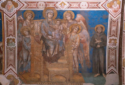
Francis had long been Italy’s most popular saint. He was the alter Christus, the first saint to bear stigmata. In medieval Italy, that was already astonishing enough, which helps explain why he was canonized so quickly—just two years after his death.
Mussolini did not invent the nationalization of Saint Francis: he intervened on a figure that had already been appropriated and reinterpreted by several traditions in the 19th century. All movements seeking to build a new Italy sought to claim him. Francis was regarded as the founder of a national literature expressing a popular religiosity. The Canticle of the Creatures, composed in 1225 in Umbrian dialect, stands as one of the earliest national literary texts not written in Latin. The Divine Comedy is a difficult text to access, read mainly in high school. Conversely, Italian translations of the Cantico delle creature existed as early as the 17th century.
There then existed the Guelf or rather neo‑Guelf movement around Vincenzo Gioberti (1801-1852). It was he who, in 1843, wrote that Francis is “the most lovable, the most poetic and the most Italian of saints,” a formula later enshrined in 1939 by Pius XII who would speak of the “saint of the Italians and the most Italian of saints,” following a revival by Gabriele D’Annunzio in 1919 in a speech at the Capitoline. The papacy uses him, and Mussolini does too. The aim is to win the support of the Catholic masses by highlighting a figure already widely popular.
For the same reason, the socialist movement—seeking to adapt its anticlerical stance to the religiosity of peasant masses—took up the figure of the Cristo rosso at the end of the 19th century. Socialist anticlericalism is reformulated: the Church must return to the true message of the Gospel, in the spirit of the Poverello. This contributed to boosting Francis’s popularity among the peasant masses in the North and Center of the country.
Thus Mussolini braids together all these memories: nationalist memory, Catholic memory, and socialist memory.
At what cost of distortions and reappropriations does this valorization of Saint Francis take place under the fascist regime?
It wasn’t Mussolini who initiated it in 1925: it was the mayor of Assisi, Arnaldo Fortini. He had been elected on the lists of the Popular Party before joining fascism and becoming podestà. This is an example of clero-fascism, which does not concern only the country’s Catholic elites but also originates from below, in this case from a municipal staff choosing fascism out of fear of rural unrest and a desire to restore order. At once fascist and Catholic, Fortini approached the presidency of the Council and urged Mussolini to intervene to organize festivities and renovate the basilica and the city of Assisi.
Mussolini quickly saw the utility of the operation. By voting for the establishment of a public holiday on October 4, he sent a useful signal to the Holy See, as negotiations for the Lateran Accords were about to begin. At first, he did not seek to fascistize Francis’s figure. On the contrary, the fascist state put itself at the service of the Holy See. In the message he sent to Italian embassies on November 28, 1925, where he lists the great figures Italy has offered to the world, he proclaimed:
“Italy, with Francis, has also given to Christendom and to humanity the most holy of saints. […] And it is with the Saint from Assisi that Italy, though still beset by the harsh trials of the Middle Ages, reveals, as it were, the first signs of its renaissance and asserts its renewed qualities of courtesy and humanity. Saint Francis, who had taken part in communal struggles, suddenly rises as if lifted beyond the world, above the dazzling whirl of passions of his era, brandishing the cross in his gaunt hands, the glorious insignia of charity and peace.”
Charity and peace do not appear to be key elements of fascist propaganda…
Indeed, these were the aspects the Holy See highlighted for the 1926 festivities. What Mussolini sought was a re‑interpretation of Francis as a warrior and a peacemaker. This is the fascist regime’s core perversity: presenting itself as the political solution to end violence and a civil war of which it had been the vehicle.
As the celebrations approached, Francis’s figure was gradually fascified. Paolo Ardali, a priest from northern Italy, published in the summer of 1926 an essay entitled San Francesco e Mussolini, in which he drew a parallel between the two men. Everything concerning Francis’s Franciscan poverty was inverted: no longer presented as social contestation, as with the socialists, but as an endorsement of discipline, acceptance of the established order, and self‑renunciation for a higher cause. The Church, for Francis; the homeland for Mussolini. Francis is also portrayed as a skeletal beggar, drawing a parallel with Mussolini who, in the trenches, sacrificed himself for the nation and endured hunger. Finally, Francis’s youth and his participation in communal wars before his religious life is cited; Ardali’s portrayal suggests the model of fascist virility even there.
Is this clerico‑fascist graft that forges a new Saint Francis a top‑down project of the new power, or does it fit into bottom‑up cultural dynamics?
A considerable portion of the Church spontaneously understands the propaganda machinery shaping around the figure of the dictator and leader of fascism, and seeks to make the two representation systems compatible, aligning Francis with Mussolini in a way that could bolster the regime’s legitimacy.
How did the revival of Saint Francis’s cult in Italy and especially in Assisi become a tool in the hands of fascist power?
Fascism aims to obscure the violence at the root of the dictatorship and to stage a people’s mass support. This is not easy, as the regime is in its infancy and the civil war is still recent: a large portion of Catholics as well as socialists—indeed most of the Italian population—are aware of fascism’s reality. Using Francis and the 1926 festivities is thus a cheap means of suggesting that the crowds, known to be sizeable, would also rally under the fascist banner.
And here a transaction takes place: Mussolini declares October 4 a public holiday and unlocks three million lire, notably for the construction of an orphanage located next to the basilica. The cornerstone is laid on October 28, 1925—the anniversary of the March on Rome. We see there the attempt to fuse the two memories, that of Francis and that of the regime, the latter presenting itself as the continuator of the saint’s work. There is also the renovation of the basilica and the city, including the construction of hotels to accommodate pilgrims during the festivities.
And it works. The festivities’ success is largely enabled by the fascist regime. The Church would not have had the financial means to prepare Assisi to receive such a large influx of tourists—about one and a half million visitors between 1925 and 1927. It is a form of patrimonial and religious tourism. The face of Assisi as we know it today was largely shaped in 1926‑1927, with the city being renovated to accentuate its medieval character. The fascists extend this approach to all of Tuscany in the early 1930s. Beyond religious tourism, the aim is also to profit economically: democratizing the Grand Tour and guiding its flows.
Did Mussolini seek to capture the aura of the saint? Did he become a thaumaturge prince or an alter Christus?
On the propaganda side constructing the Duce, the same year saw the publication of Mussolini’s biography by Margherita Sarfatti (1880-1961), his mistress, or at least his muse: Dux, whose title alludes to the theme of the restauratio imperii.
Sarfatti speaks of women from Abruzzo who, during a visit to Mussolini, want to touch him. In Sicily he is invoked as an intermediary with the dead: as a veteran, he becomes the figure who intercedes with soldiers fallen during World War I. The two classic functions of the saint, the thaumaturge and the intercessor with the dead, are thus spotlighted, in the subtext, by Sarfatti.
Until the end of the regime, a large portion of propaganda will revolve around this figure of a new alter Christus, capable of performing miracles. For example, sick children who recover after their parents place a photograph of the Duce under their pillow; in 1936, deaf and mute individuals regain speech to swear fidelity to the empire’s founder; or pregnant women who fix Mussolini’s portrait on the wall to pass its virtues to their unborn children.
The parallel with Francis in 1926 is thus only the beginning of this project to capture his legitimacy. The historian Emilio Gentile, in Il culto del littorio, precisely described the different registers of propaganda around Mussolini’s figure. The nationalist dimension and the appropriation of Romanità are often highlighted, but the third, equally important, aspect of this propaganda—recycling elements of popular religiosity related to the cults of the saints—is sometimes overlooked.
What resonance did this operation have with Pius XI, himself a Franciscan tertiary, then fixated on the Roman Question?
This dimension did not please the Holy See, but he did not voice his displeasure. It can be read between the lines in the two closest publications, L’Osservatore Romano and La Civiltà Cattolica, the Jesuit journal of intellectuals. For the Church, Francis is first and foremost a universal symbol of love and peace, but also of absolute obedience to the Church. In the project of a societas christiana of the intransigents, who are the majority among Italian Catholics, it is always stressed that Francis did not leave the Church, remained faithful to the pope, and therefore was not a heretic.
The nationalist and emphatic facet developed by fascism therefore aroused its own resistances. In the encyclical Rite expiatis, published in April 1926 ahead of the commemorations, Pius XI urged the faithful to avoid “that imaginary figure that the followers of modern errors willingly make of the saint.” This indeed references the anti‑modern tradition of the intransigents; since the Syllabus of 1864, the pope condemned “unrestrained nationalism.”
For the Church, genuine love of country must not be confused with militant nationalism. This encyclical already shows that, even as the Church forms a diplomatic relationship with the fascist regime to settle the Roman Question, it has no intention of yielding doctrinal or spiritual authority.
These tensions would become more explicit in the 1930s, with the encyc Divini illius Magistri on youth education (31 December 1929) and the 1931 clash around Catholic Action (Non abbiamo bisogno), then with issues surrounding racism and the 1938 anti‑Semitic legislation.
The proclamation of Francis as Italy’s patron saint by Pius XII in 1939 ultimately served as a means to oppose the regime. Francis is re‑presented again as a symbol of love and peace, not as a warrior and nationalist saint. It is a way to close the chapter of a saint temporarily captured by the fascists for about fifteen years and to return to the Church’s traditional stance on Francis and, in particular, to the view that Italy, as a Catholic nation, must first obey the Holy See.
By the play of anniversaries, and by coincidence, what does Giorgia Meloni’s desire to, in turn, leave her mark on the national calendar by reinstating this holiday reveal?
Two elements, in my view, must be kept in mind about Giorgia Meloni’s political strategy. The first concerns her current dominance within the governing right‑wing coalition, which is made up of three sectors that have repeatedly been the leading forces: first the economically liberal wing linked to Silvio Berlusconi, then the Northern League led by Matteo Salvini, and finally the nationalist right, inheritor of neo‑fascism, with Meloni at the helm.
In the power dynamics among these three currents of the Italian right, the Catholic vote plays a crucial role. When Christian Democracy collapsed in the early 1990s, Catholic voters split roughly evenly between the left—giving rise to the Margherita led by Romano Prodi, which then merged with the Democrats of the Left (the heirs of the Communist Party) to form the Partito Democratico—and the right.
Catholics, however, are a voting bloc that participates more than others and can be mobilized for what remains, in their eyes, the most important matter: that the organization of society should roughly follow the precepts of the Gospel. This Catholic intransigence evolves, of course, especially among those who now vote left, where liberal Catholicism—viewing faith as a matter of individual piety—advances gradually from the 1960s onward, and more markedly toward the end of the 20th century.
In the competition among the three components of the Italian right, Meloni has gambled that the steadfast support of a Catholic vote will be decisive to outpace her rivals. She has even built her political ascent on this dimension—famously captured in her October 19, 2019, speech in Rome: “I am Giorgia, I am a woman, I am a mother, I am Italian, I am Christian.”
She has sought to present herself as the best representative of a certain national‑Catholic outlook, reactivating themes characteristic of Cold War Catholic intransigence but adapted to today’s situation. She rekindles something akin to the Lepanto syndrome. In Pius XII’s Italy, the slogan carried apocalyptic tones claiming that Christian civilization was threatened at its core by the new communist barbarians from the East. In the 21st century, this Catholic‑Italy would again be on the brink of invasion, this time by Muslims, as the Western Christian world would have been by the Ottomans in the sixteenth century. Meloni has thus constructed herself politically as the strongest defender of a Catholic identity identified with the Italian nation and poised to be overwhelmed.
What does this event reveal about the relationship between Meloni and Mussolini? Does it suggest a historical continuity with fascism, which Meloni has publicly and repeatedly disavowed?
To outmaneuver her political opponents on the right, Meloni has drawn on the political culture she comes from, notably marked by opportunistic, even cynical, attitudes toward religion. This was precisely Mussolini’s tactic in the early 1920s, when he came from socialist anti‑clericalism to seize and then consolidate power.
The instrumentalization of the Church and Catholic religion was less central for the right since the 1990s, whether under Bossi, Salvini’s predecessor, or Berlusconi. The latter always preferred to emphasize anti‑communism, but an anti‑communism whose religious matrix had been neutralized or at least not foregrounded.
Under Berlusconi, relations between the Holy See and the government were sometimes complex and even deteriorated in the late 2000s due to morals scandals that struck the leader of Forza Italia and a number of blasphemous jokes perceived as offensive by the Vatican. By contrast, for Giorgia Meloni the idea of pleasing the Church is paramount: to grant it enough—at least symbolically—for it to remain neutral toward the new regime in power.
Which Saint Francis do today’s Italian conservatives foreground? How do they reconcile him with other iconic portrayals: the patron saint of animals and ecology, a precursor of ecumenism, the poor among the poor, and the figure that Pope Francis has brought to the fore, notably with the encyclical Laudato si’ which opens with a quote from the Canticle of the Creatures?
The Franciscan parable is an almost inexhaustible well. The Canticle of the Creatures can obviously be read today through an ecological lens, emphasizing respect for Creation. The same logic applies to ecumenism. Meloni, absorbed in defensive Catholicism, moving toward a kind of reconquista, interprets Francis’s 1219 journey to the Holy Land and his meeting with Sultan al‑Kamil as an offensive mission of conversion of the infidels. But this reading clashes with another, deeply rooted and reinforced by Vatican II, which sees in it a will for peaceful coexistence among religions, under the banner of universal brotherhood.
The figure of Francis naturally lends itself to many readings. Yet the Church’s traditional interpretation, centered on a message of peace, seems better grounded and thus more convincing than the reading that makes him a warrior. Saint Francis is the one who renounces his father’s inheritance and lays down his clothes before the bishop of Assisi, not the one who takes up the sword to fight the troops of Spoleto or Perugia.
Ultimately, Meloni aligns herself with a tradition that has also become classic: the nationalization of the saint, a trend dating back to the 19th century, which fascist rhetoric had already attempted to steer in a more aggressive direction. It all depends on the kind of nationalism one claims: an open nationalism or an exclusionary one. On this point, the interpretation chosen by the current Prime Minister is not without danger for her political trajectory.
In what sense?
Francis belongs to many communities, in the sense that Franciscan memory has accreted through layers of memory: those of the Church since the 13th century, but also those of the socialist movement that were absorbed by the left wing of the Christian Democrats, those whom France would call the “social Christians,” and in Italy long referred to as the cattocomunisti. For them too, the Poverello remains a central figure in expressing their faith. Attempting to hegemonize and appropriate Francis by imposing one’s own reading during a religious commemoration may also be read as a confession of weakness.
The majority of Italian Catholics will understand very well what she seeks to do and will not necessarily thank her for it. She does not go in humility, serving the message of Francis, but as a party leader who wants to defend her own reading of the Franciscan legend.
Her trip to Assisi today is by no means incidental: even Mussolini did not do it a hundred years ago and preferred to stage himself in Rome, humbly listening to the radiophonic retransmissions of the festivities, as if he placed himself at the service of the Church.
We have mainly explored the political dimension of Saint Francis’s memory. What about other figures in Italian culture, particularly in Italian cinema? What remains of Rossellini (The 11 Fiori de Saint Francis of Assisi, 1950) and of Pasolini (Des oiseaux petits et gros, 1966) in our contemporary perception of the Poverello?
Saint Francis has appeared in Italian cinema from its earliest days, marking the extraordinary popularity of Assisi’s saint. The first film, San Francesco il poverello d’Assisi by Enrico Guazzoni, dates from 1911. The second, Frate Sole by Ugo Falena, goes back to 1918 and is set within a particular context: a genuine epidemic of christomimesis, the most famous example being Padre Pio of Pietrelcina, who would allegedly receive the stigmata in September of that year—roughly the same date as the illustrious 1224 predecessor, which is no accident.
Religious anthropologists have interpreted this multiplication of miracles reproducing the Franciscan legend as a symbolic compensation for the mass deaths in the trenches, a trauma so powerful that it required recourse to a category of miracle genuinely extraordinary.
Later, on the occasion of the 700th anniversary of 1926, Giulio Antamoro produced Frate Francesco, released in 1927, whose romantic styling drew some reservations from Franciscans, for example with Father Vittorino Facchinetti, who responded by delivering the first radio sermon, intended to last three years, focused on the real life of Francis. In 1929, the Capuchin Theodosio Da Voltri followed, but in a nationalist fascist sense, which did not help improve relations between the two orders.
In 1950, Roberto Rossellini’s film belongs to the neorealist current. What I find interesting in these productions is that the figure of Francis serves as a recourse whenever the nation and the Italian people are spoken of, which shows how thoroughly the saint’s nationalization—begun in the 19th century—has functioned and has been absorbed by Italian society, with each filmmaker reexpressing Francis in their own aesthetic language.
Until Pasolini’s film, which is first and foremost a pessimistic meditation on the destruction of an ancestral, peasant Italy by urban and industrial modernity, with two anti heroes wandering through unfinished suburban landscapes where life loses its meaning. Pasolini ties this reflection to Palmiro Togliatti’s funeral, the Communist Party’s secretary who died in 1964, whose images punctuate the narrative at regular intervals.
These two narrative strands are, in fact, complementary: with Togliatti’s death, the director sees the end of a era in the Communist Party, that of a powerful party capable of opposing the transformations at work in Italian society and thus the ability to oppose the advent of the reign of commercial consumerism. In this apocalyptic vision, whom does Pasolini summon? Francis, the one who knew how to speak to the birds and thus to usher the supernatural into life. From then on, no one would be able to do so, and the two protagonists do not heed the croaking warnings of the crow that accompanies them—they are ultimately devoured, lost in a country that has renounced its soul.