
According to sources familiar with the discussions, the Chinese government is poised to authorize several of its major technology companies, including ByteDance and Alibaba, to purchase Nvidia’s latest-generation graphics cards, the RTX PRO 5500. This would represent a significant opening signal to American chips, following this summer’s purchase of roughly 10,000 H200 chips by ByteDance and Tencent 1.
- Beyond the American export controls that limit sales of advanced chips to China, Beijing restricts their entry into its market by requiring each purchase to be approved in order to favor Chinese manufacturers, such as Huawei 2.
- The effectiveness of this strategy remains limited, however: Chinese chips are not yet produced in sufficiently large quantities nor sufficiently performant to meet domestic demand, particularly that of the major players 3.
- Such an authorization would signal a degree of pragmatism on the part of the Chinese regime, which would acknowledge the shortcomings of Chinese chips 4.
Some Chinese buyers are planning to integrate these Nvidia RTX PRO 5500s into servers to run AI models for their clients.
- ByteDance alone would consider ordering around one million units, according to The Information.
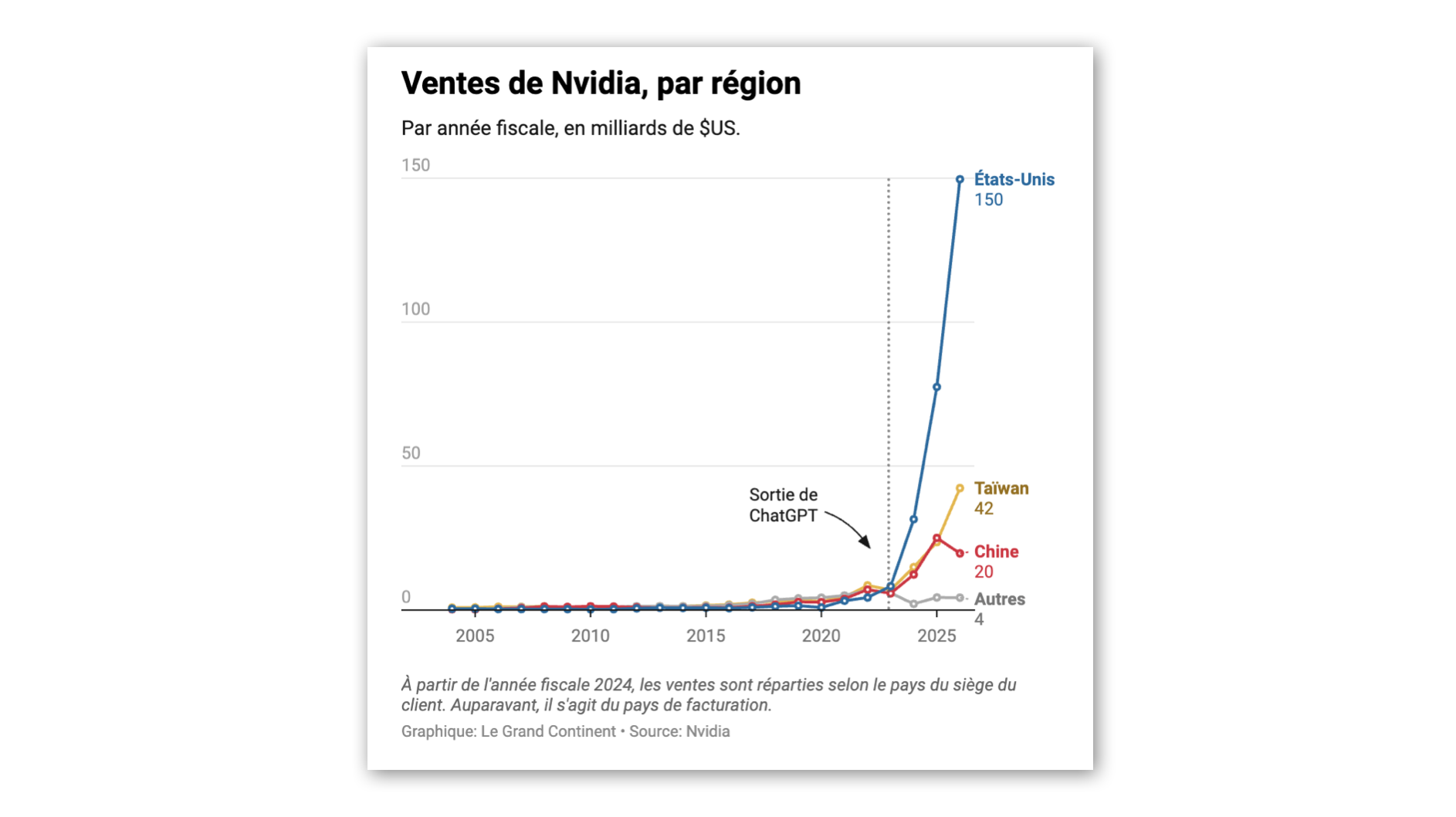
- At the price charged in China, such an order would amount to $13 billion, i.e., the equivalent of two-thirds of Nvidia’s sales to Chinese customers during the 2026 fiscal year, which ended in January.
This decision would come just a few days after Xi Jinping’s state visit to Washington, after which few concrete announcements were made.
- Jensen Huang, co-founder and CEO of Nvidia, and Lisa Su, head of its rival AMD, were among the rare guests seated at the table of Donald Trump and Xi Jinping at the state dinner held at the White House on Thursday, September 24.
- Huang and Su are seeking to regain access to the Chinese market, largely closed by the export controls established by the Biden administration in October 2022 and maintained, or even tightened, by the Trump administration.
- Nvidia and AMD also oppose bipartisan bills aimed at further restricting the sales of AI chips and semiconductor manufacturing equipment to China. The Senate included them in July in its version of the National Defense Authorization Act (NDAA) for fiscal year 2027.
Official accounts of the Trump-Xi summit do not mention American export controls, and Washington says they were removed from trade negotiations. According to the U.S. Trade Representative, Jamieson Greer, they were not discussed either during the AI-safety talks between Chinese Vice Premier He Lifeng and Treasury Secretary Scott Bessent on September 20.
Sources
- Qianer Liu, « China Weighs Allowing Purchases of New Nvidia Chips by ByteDance, Alibaba », The Information, September 27, 2026.
- Zijing Wu, « China eases limits on Nvidia H200 chips as AI race escalates », Financial Times, August 19, 2026.
- Wendy Chang, In taking H200 chips, Beijing balances self-reliance goals with AI growth, MERICS, March 4, 2026.
- Vincent Lee, « China May Let Alibaba Buy Nvidia’s RTX Chips, Information Says », Bloomberg, September 27, 2026.