
Until August 20, the Grand Continent will publish in open access The Vocabulary of the Far Right , the product of collective work by a group of researchers—sociologists, historians, political scientists, sociolinguists—from across Europe under the direction of Steven Forti. To receive each lemma in your inbox and support the work of an independent editorial team, subscribe
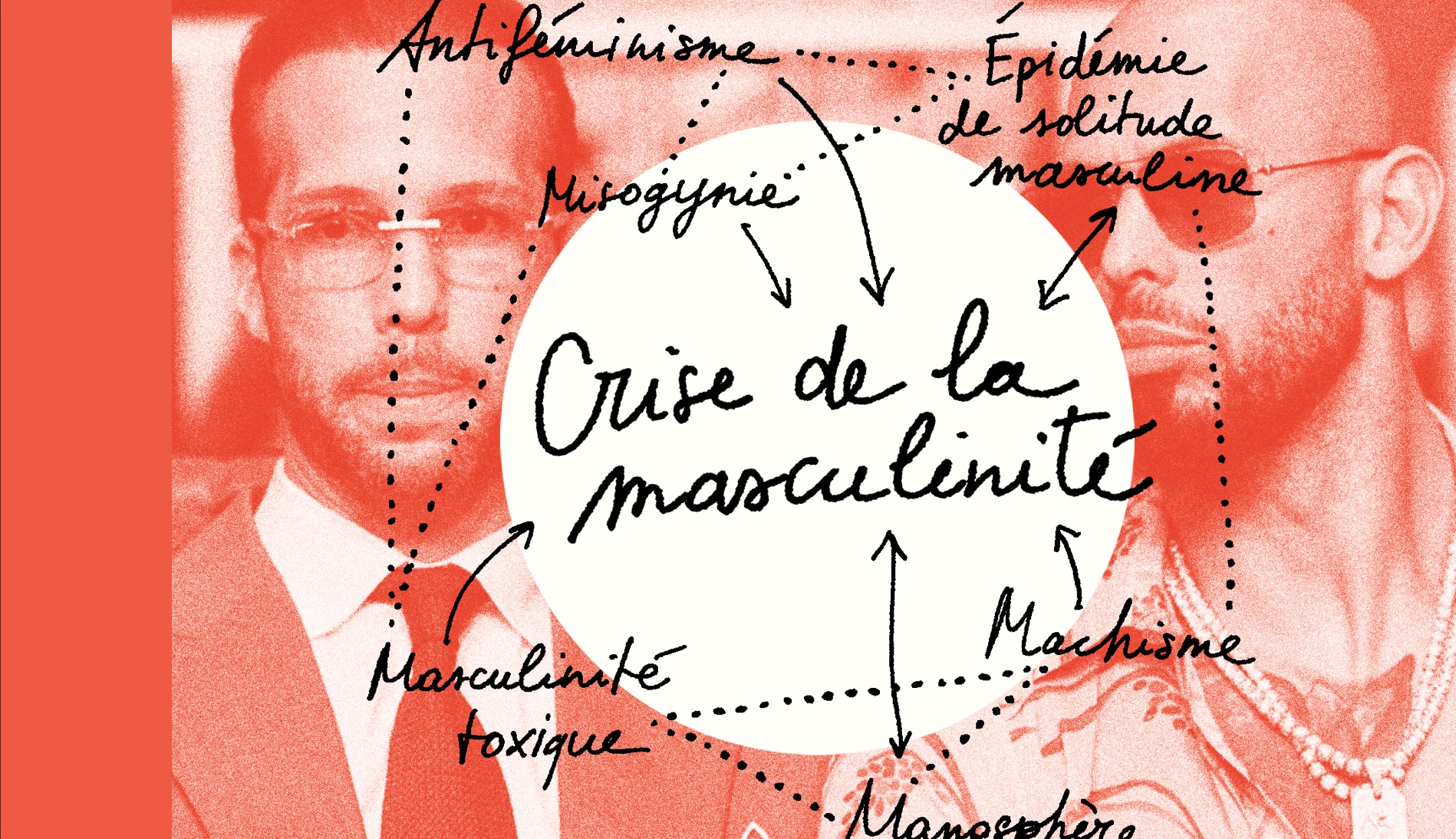
In roughly a decade, the phrase “crisis of masculinity” (crisis of masculinity) has travelled from gender-studies journals to podcast studios, to political rhetoric, to parliamentary committees and online comments, across Europe, North America and beyond.
More recently, it has been linked to the “male loneliness epidemic” (male loneliness epidemic): men are said to be more isolated today, with fewer friends and more emotional disorientation than in the past. In 2023, Vivek Murthy, then United States Surgeon General, issued an official advisory warning of a national “epidemic of loneliness and isolation” . Figures such as Andrew Tate – a British-American influencer known for promoting a hyper-masculine, anti-feminist discourse, arrested in Miami on July 18, 2026 in preparation for extradition to the United Kingdom , where he is being prosecuted with his brother Tristan for rapes and human trafficking, and whom we referenced in our lemma on the “Red Pill” — describe this loneliness epidemic as a distinctly masculine phenomenon. They present the “crisis of masculinity” as the consequence of a feminized and hostile society that would have deprived young men of the place and status they believe they are owed.
Late 2025, Scott Galloway, a professor at New York University and media figure, published Notes on Being a Man , a work that drew wide media attention from The Guardian to CNN and Oprah Winfrey’s podcast. He depicts a generation of young men facing declining academic performance, increasing economic precarity and deep social isolation. Galloway presents himself as liberal, pro-feminism and committed to data-driven analysis rather than ideology. Yet his reading follows a well-worn pattern: men have lost something, they are now the first to fall behind, and the solution lies in restoring a masculine role or mission—a pattern that has recurred in various forms for more than a century.
At the same time, the phrase “crisis of masculinity” serves to designate both masculine vulnerability and male aggression. In April 2026, the British teaching union NASUWT published a survey of more than 5,000 teachers warning that “a crisis of masculinity is developing in British schools”: nearly one in four female teachers reported misogynist abuse from students in the past year, versus 17.4% in 2023 . Among the incidents reported were sexualized behaviors: AI-generated nude images of female teachers, jokes about sexual assaults, or refusal to follow instructions given by women. The union’s general secretary, Matt Wrack, highlighted a link between these behaviors and the content produced by Andrew Tate and Donald Trump .
These two usages of the same term reveal a defining feature of the moment. Boys and men are simultaneously depicted as victims and as threats: lone and disoriented on one side, actors of harassment and radicalization on the other. The crisis narrative typically links the two, contending that vulnerability begets aggression. The validity of this argument, and what it conceals, deserves examination.
Which masculinity are we talking about?
The narrative of the “crisis of masculinity” rests on a familiar logic: the traditional roles of men as providers and protectors have been eroded without being replaced. Yet it raises a question: which masculinity are we talking about? This is where the concept of hegemonic masculinity (hegemonic masculinity), developed by Australian sociologist Raewyn Connell from the 1980s and refined with James Messerschmidt in a widely cited 2005 article in Gender & Society, becomes indispensable. Hegemonic masculinity does not denote an average behavior, but the dominant cultural ideal. The form of virility presented as the norm to which all men are compared, but which most men fail to achieve: economic success, emotional mastery, sexual assertiveness, heterosexual normativity, independence—these are all elements that define this standard. The “crisis” is thus not a crisis of all men or of all forms of masculinity, but of this particular hierarchical ideal which, within Connell’s discursive framework, also functions as a power mechanism legitimating male domination over women and the domination of some men over others.
When commentators speak of a “crisis of masculinity” without specifying which masculinity they mean, they may end up—consciously or not—bolstering the norms whose effects are most deleterious. French-Canadian political scientist Francis Dupuis-Déri, in his “Autopsy of a Tenacious Myth,” traces the pervasiveness of this discourse across regimes and through time: structurally constant, it is always organized around the idea that women are taking men’s places. In the European academic debate, German sociologist Sylka Scholz notes that the notion of “toxic masculinity” is replacing “crisis of masculinity” as the main interpretive framework, except in right-wing discourse, where the crisis framing persists precisely because it is politically useful.
Indeed, in Spain, a January 2025 survey by the Center for Sociological Research (CIS) placed the far-right Vox party at the top of popularity among 18–24 year olds, with 29% support among men versus 16.5% among women. Likewise, in Germany’s 2025 federal elections, the AfD captured 24% of young men’s votes, while young women favored the left-wing Die Linke. This cleavage is not explained solely by gender (insecurity, downward mobility, and political distrust play roles), but gender is a central lever. As Austrian political scientist Birgit Sauer has shown, the far-right’s strategy around masculinity is double: first invoke a crisis, then promise a restoration of masculine dominance within the family, the right to aggression, and heterosexual clarity as the solution. The emotional logic is recognizable across contexts: something that rightly belonged to men has been taken away, this loss is not their fault, and restoration is the only remedy.
What the data say
The notion of the “male loneliness epidemic,” whose usage has spread widely in recent years, extends this same narrative frame. The central idea is that men today have fewer close friends and support networks than previous generations. The data on the topic are real, but require caution. In the United States, a 2021 survey by the American Perspectives Survey found that the share of men reporting no close friends rose from 3% in 1990 to 15%, while the share with at least six close friends fell from 55% to 27% . Comparative data, however, temper the idea of a phenomenon unique to men. A 2025 Gallup study shows that, in most OECD countries, young men do not report loneliness levels significantly higher than the national average, with the United States an exception . Meanwhile, an OECD report covering 22 EU countries indicates that 8% of the population has no close friends, with no notable gender difference, while noting that several countries, including Germany, Finland, and Spain, have launched national strategies to combat loneliness .
What emerges most clearly is not that men are lonelier than women, but that their forms of connection are structurally more precarious. Italian sociologist Manolo Farci describes a “spalla a spalla” friendship (shoulder-to-shoulder): men do things together, but do not look each other in the eye. The norms of hegemonic masculinity render emotional intimacy among men socially risky, while romantic relationships become the principal, even the only, space where vulnerability can be expressed, experienced less as a true form of connection and more as a marker of status and masculine success.
Another frequently invoked argument points to biology, namely the documented decline in average testosterone levels. Studies have indeed shown a generational decline of about 1% per year since the late 1980s, independent of age, a trend whose causes—still debated—are attributed more to health and environmental factors (obesity, sedentary lifestyles, endocrine disruptors) than to any real loss of virility. This observation, however, has been widely amplified and reinterpreted on social networks. A 2026 study by the University of Sydney shows that many influencers present mundane experiences (fatigue, stress, lowered libido) as symptoms of a supposed “testosterone deficiency,” while promoting hormone therapy as a solution and treating testosterone levels as a direct indicator of virility. The researchers label this phenomenon the “medicalization of masculinity” (medicalization of masculinity): an ordinary biological variation is transformed into a crisis calling for commercial intervention, through narratives that closely echo the mechanisms analyzed in our previous article. This logic has now reached the state sphere: on July 15, 2026, U.S. Secretary of Defense Pete Hegseth announced in a video titled “High-T Department” an annual screening for “testosterone deficiency” among military personnel over thirty, paired with a offer of hormone-replacement therapy, to ensure soldiers “the right levels of testosterone to operate at the best of [their] capabilities”.
Psychology research consistently shows that men socialized to the norms of hegemonic masculinity (self-sufficiency, emotional control, toughness) are far less likely to seek help when facing mental-health difficulties, and have a higher suicide risk. In England and Wales, male suicide rates are about three times higher than female rates; in the United States, about four times higher. Suicide remains, of course, a multifactorial phenomenon, no single factor can fully explain it, but it is important to note that the documented psychological consequences are linked to hegemonic masculine norms themselves rather than to feminist critiques that challenge them.
A myth older than online life
The “crisis of masculinity” is not, contrary to what it often claims to be, a new diagnosis. It is a recurring narrative, reactivated and reconditioned each time women’s social position evolves. Dupuis-Déri traces it back at least to Roman antiquity. As British sociologist John MacInnes observed, “masculinity has always been in crisis in one way or another.”
Michael Kimmel’s work on masculinity in the United States shows that, as early as the late 19th century, industrialization and the emergence of the first women’s rights movement sparked a anxious reaffirmation of masculine ideals. The 20th century reproduced this dynamic. The model of the household head that dominated after World War II relied on relegating women to the domestic sphere. When second-wave feminism challenged this order in the 1960s and 1970s, the narrative of a “crisis of masculinity” resurfaced. In the early 1980s, what began as a men’s liberation movement had largely become a men’s rights movement, presenting masculine resentment as the result of victimization attributed to feminism.
Dupuis-Déri also showed how the masculinist narrative of this crisis formed a structural pillar of Italian fascism and National Socialism, both of which presented the crisis of masculinity as a betrayal by a feminized elite and proposed a virile restoration as the solution. Spain’s case is equally instructive: as Spanish sociologist Zira Box has shown, Francoist nationalism rested on an explicitly virile conception of the nation, in which military masculinity served as an antidote to the supposed weakness and feminization of the Republic. In France, this lineage runs through Alain Soral and Éric Zemmour, who published masculinist texts before becoming leading extreme-right ideologues. In Vers la féminisation? (1999), Soral claims to dissect an “anti-democratic plot” in which “the feminization of minds” would complement the “Maastrichtisation” of institutions. In Le Premier Sexe (2006), Zemmour argues that “as men feminize, they become sterile; they forbid themselves any audacity, any innovation, any transgression,” going so far as to attribute Europe’s “intellectual and economic stagnation” to its “feminization.”
American journalist Susan Faludi analyzed this antifeminist backlash in Backlash: The Undeclared War Against American Women (1991), and then in Stiffed: The Betrayal of the American Man (1999), where she contends that working-class men have indeed been abandoned by economic and social shifts and that they were offered, as a substitute, an “ornamental masculinity” based on image and performance. This logic resonates in the contemporary culture of looksmaxxing, where systematic optimization of physical appearance becomes a substitute for the productive or social identity once offered by traditional masculine roles.
In Iron John (1990), American poet Robert Bly urged men to reconnect with what he called the “deep masculine,” a raw, instinctive energy embodied by a mythic figure of the wild man, repressed by civilization and domesticity. The book was meant more as therapy than denunciation, but its core structure—the idea that there exists an authentic masculinity, a primal force weakened by modern society—already anticipates the logic of figures like the contemporary manosphere’s “Chad”: an idealized archetype of natural, dominant masculinity, an implicit standard by which other men are measured and deemed lacking. In both cases, the archetype remains recognizable. What changes is how it is used: from a supposed tool for psychological integration, it becomes an instrument of social hierarchy.
The 1990s also saw the migration of men’s-rights communities—born from this shift—toward the first online forums. These spaces did more than vent grievances; they offered something truly missing for lonely, disoriented men: a community, a shared language, and a sense of recognition. The painful irony, often overlooked in solitude literature, is that the manosphere provides some men with a form of community they cannot easily find elsewhere, precisely because of the dominant norms of masculinity. It is thus at once a response to male loneliness and a cause of its most problematic forms. Its most radical fringes have already turned to violence: in the United States, the Isla Vista massacre in 2014, whose author, Elliot Rodger, published a misogynist manifesto announcing his intent to “punish” the women who rejected him before killing six people, and the 2018 Tallahassee yoga-studio shooting were carried out by young men who identified with the “incel” movement (involuntary celibates), of which Rodger has since become a genuine figure of veneration.
The crisis of masculinity and the male loneliness epidemic point to real difficulties. Data on male support networks, suicide rates, and testosterone levels are not imaginary, and this is precisely why political forces that seize on them find such resonance. These problems deserve serious attention; the key is to identify their causes correctly. Yet the “crisis” narrative attributes them to feminism and women’s progress while defending the norms themselves (stoicism, emotional restraint, implicit prohibition on seeking help) that produce the damages. It recycles a rhetorical framework that reappears with striking regularity whenever gender relations evolve, and this has been the case since the 19th century.
The most honest—and perhaps ultimately the most useful—conversation about men’s well-being distinguishes two elements: real difficulties that require political and social responses, and the ideological narrative that instrumentalizes these difficulties to oppose gender equality. It also requires not waving away this malaise with a shrug: mocking it would allow the manosphere to monopolize its management. It is a conversation more demanding than the one proposed by the “crisis of masculinity” industry. And that is precisely why it is necessary.