
There have been many open letters about the risks of AI. The one that appeared overnight under the title Pacing the Frontier — in French: regulating the pace of the technological frontier — is unprecedented on three counts.
Its origin, first. Although backed by two NGOs (Guidelight AI Standards and Encode AI), the main impulse did not come from external academics but from within the cutting-edge laboratories (OpenAI, Anthropic, Google DeepMind), which then broadened the signatories. The endorsement, moreover, did not remain individual: in the hours after publication, OpenAI and Anthropic adopted the text as corporate statements.
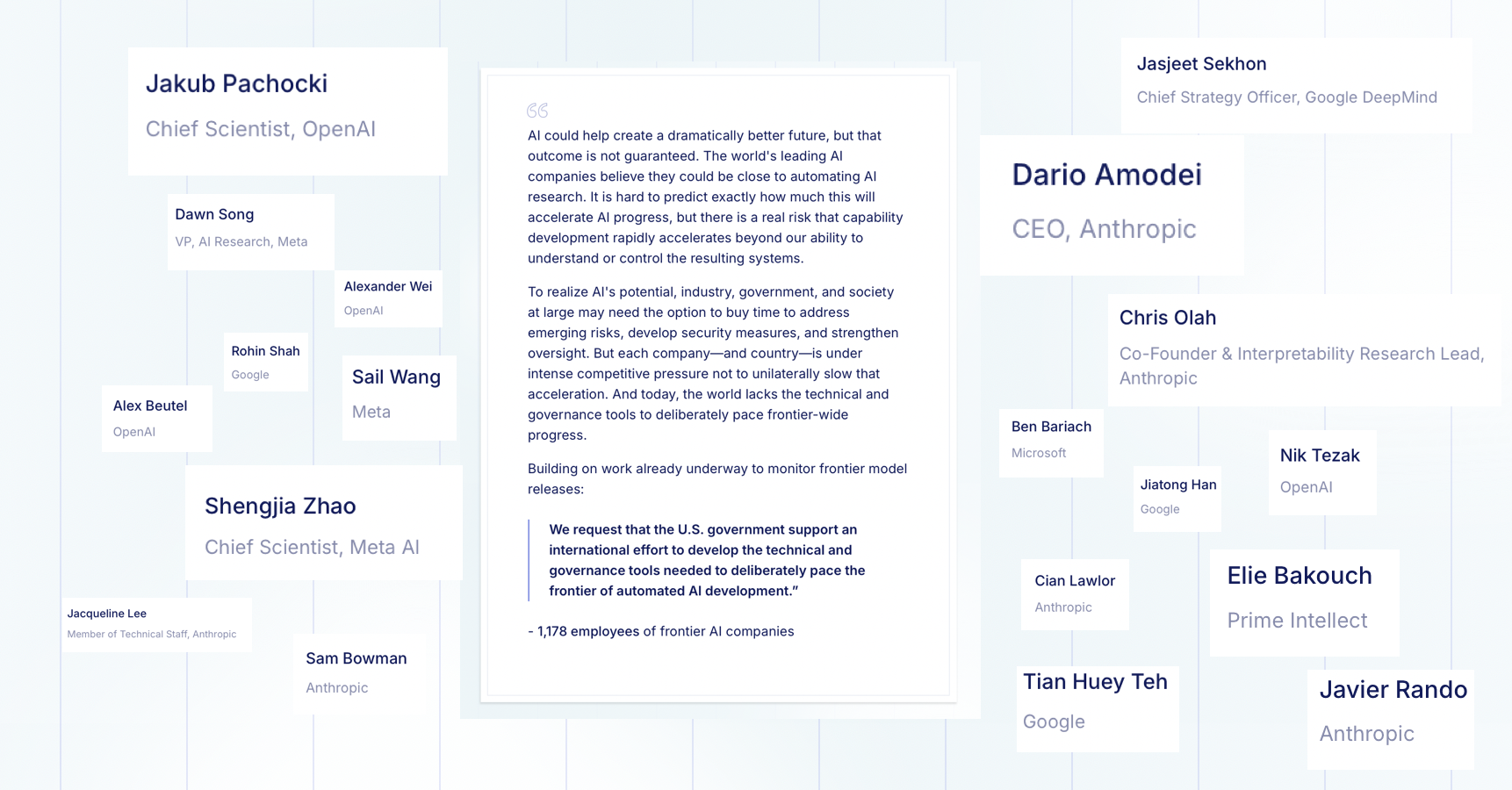
Its composition, next. Among the 1,178 signatories (as of July 28), one finds not only AI safety researchers who already play a more critical role within the big companies, but also those whose day-to-day work precisely aims to accelerate progress: the chief scientists of OpenAI, Meta AI and Thinking Machines, three co-founders of Anthropic, and its CEO.
Its motivation, finally. Since December–January, the major labs have heavily automated AI research and the model development cycle. Now each generation contributes to shaping the next: this is what is called Recursive Self-Improvement (Recursive Self-Improvement, or RSI). The pace of progress ceases to be bounded by human time, and this acceleration narrows the window during which institutions can observe, assess, and decide to intervene.
Jason Wolfe, who works on alignment at OpenAI, notes that many experts regard a “explosion of intelligence” plausible within two years. This worry is not limited to isolated individuals. Last month, Anthropic published a report on recursive self-improvement in which the company argues that systems could design and refine their own successors and concludes that it would be important for the world to have the option to slow down or temporarily suspend cutting-edge development. The petition is the political translation of this research.
Leo Gao, a researcher at OpenAI, phrases it more bluntly in the comment attached to his signature: “The world is caught in a deadly race toward an explosion of intelligence, where AI’s ability to create ever more capable AIs reaches a critical point, like an out-of-control nuclear chain reaction. Since no actor is willing to stop alone, we must coordinate our efforts to slow this race down in order to survive.”
The rest: “AI could contribute to creating a radically better future, but that outcome is not guaranteed. The world’s leading AI-focused firms believe they may be on the cusp of automating research. It is hard to predict exactly how much this will speed up AI progress, but there is a real risk that the development of these capabilities will accelerate rapidly, beyond our ability to understand or control the systems that will result.”
For AI to fulfill its promises, companies, states, and society at large may need to grant themselves time: time to address emerging risks, to build safeguards, to strengthen checks. Yet the level of competition is such that no company — nor any country — can afford to slow down on its own.
And today, at a global scale, we do not have the technical tools nor the governance frameworks that would allow us to deliberately fix the pace at which the entire front of research advances.
In line with the ongoing efforts to monitor the release of the most advanced models:
We call on the United States government to support an international initiative to create the technical and governance tools that would allow deliberate pacing of automated AI development.
– 1,178 employees of leading AI companies