
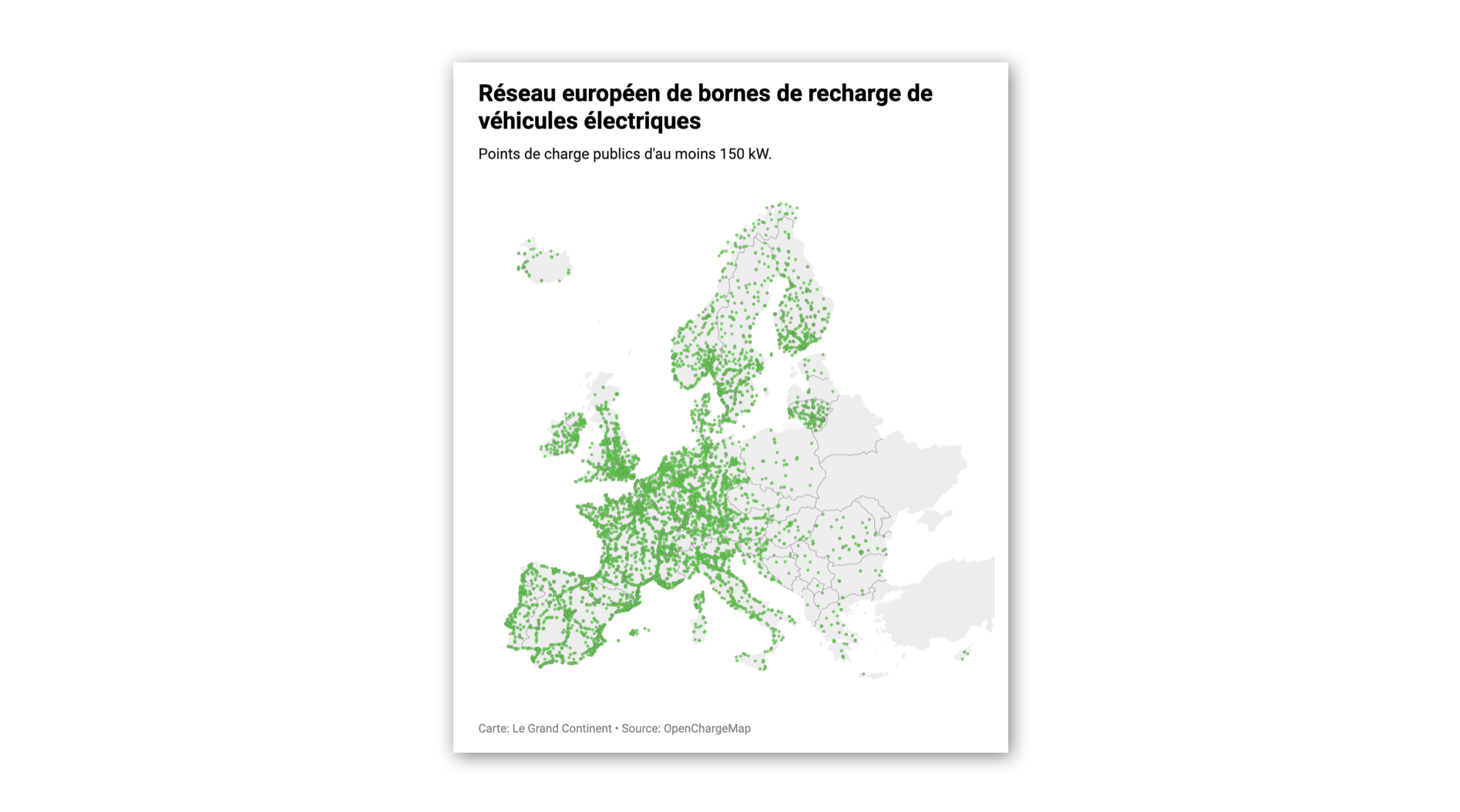
According to data compiled by Transport & Environment (T&E), the European network of public charging stations for electric vehicles has grown substantially: the continent counted 1.1 million public charging points last year, five times more than in 2020 (about 200,000).1
The network is expected to nearly double by 2030, reaching 2.1 million public charging points.
- Europe is the continent that, to date, has the best network to accommodate several million electric vehicles.
- The charging power target, set by the AFIR regulation (“Regulation on the deployment of infrastructure for alternative fuels,” adopted in 2023 and in force since April 2024), has already been achieved at the European level, surpassing the target by more than 180%.
- In the first quarter, 23 member states out of 27 posted charging capacity twice as high as required by AFIR, calculated pro rata based on the number of registered battery electric vehicles and plug-in hybrids by country.
The data from T&E indicate that the development of the network has been such that the available charging capacity now grows faster than the electric vehicle fleet.
- However, battery-electric car sales continue to advance at a steady pace: 1.2 million vehicles were sold in Europe in the first half of 2026, up 34% from 2025.
- Fully electric cars currently account for 25.6% of the European market, based on 17 markets studied, and this year have posted sales records in Spain, Slovenia and the Czech Republic2.
The European charging network shows significant disparities in terms of the number of charging points per country, charging costs – which can range from under €6 in Hungary to nearly €34 in Ireland – and the technologies used. Thus, while the Netherlands has the largest number of charging points in Europe (over 220,000), the majority operate on alternating current, and are slower than direct current fast chargers3.
Charging time for vehicles now plays as important a role as range for prospective buyers.
- Last year, the Chinese automaker BYD unveiled a new line of cars capable of a full charge in as little as 5 minutes, with an entry price listed at $37,000.
- To support its European deployment, BYD plans to invest nearly €2 billion over the next five years to develop the infrastructure needed for this charging4.
- The group thus plans to roll out 3,000 ultra-fast charging points in Europe by 2027. This technology, currently available for a limited number of vehicles, could be extended to all entry-level models of the brand on the European market in the coming years.
Sources
- Car charging & AFIR targets: where do we stand?, T&E, July 20, 2026.
- Mathias de Rozario, « Europe EV sales top 1 million in first half as demand accelerates », Reuters, July 16, 2026.
- Alessio Dell’Anna, « Where is EV charging cheapest and fastest ? », Euronews, June 18, 2026.
- Kana Inagaki, « BYD to spend €2bn to build out 5-minute flash chargers in Europe », Financial Times, June 10, 2026.