
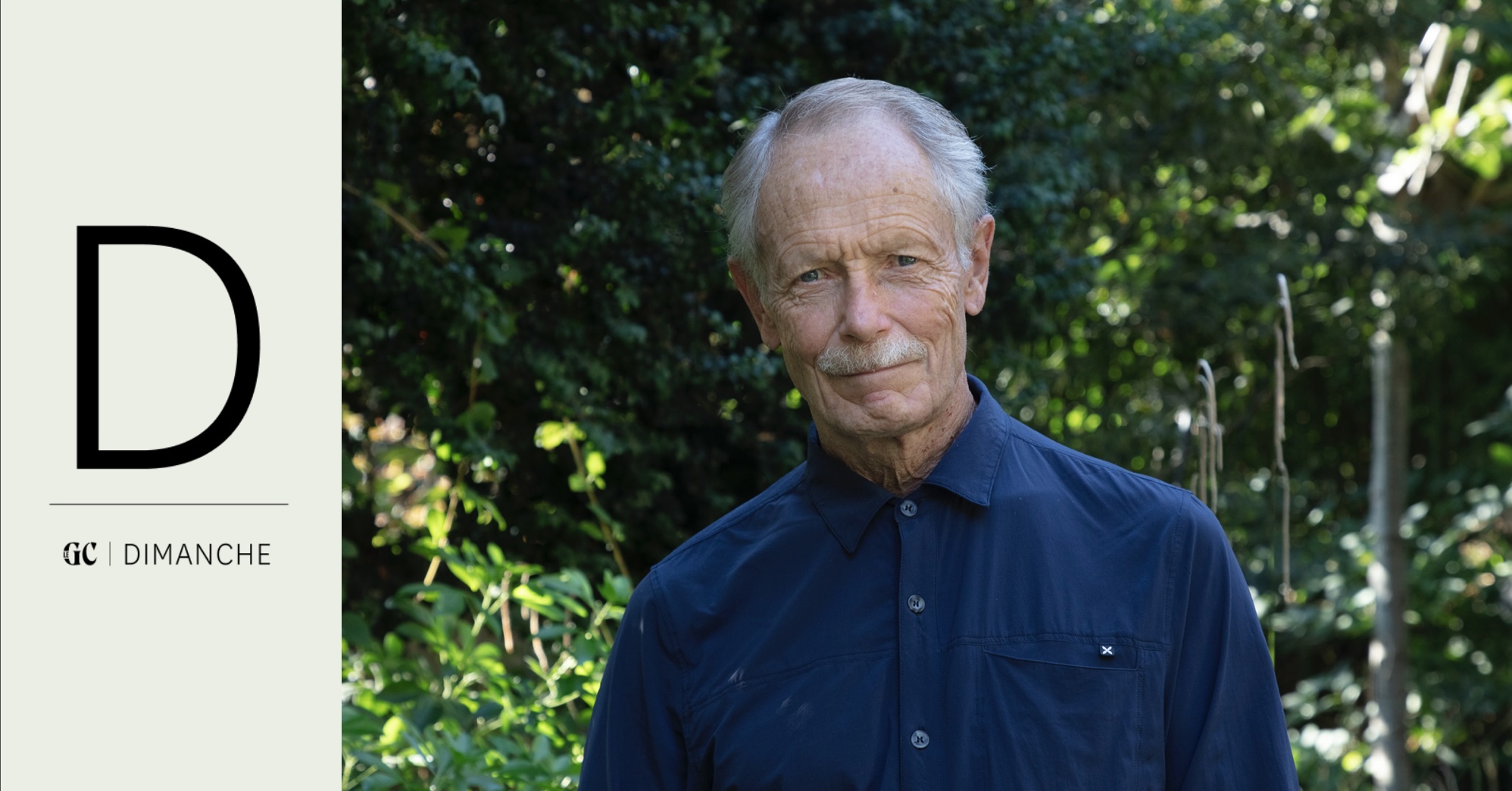
He experiences them as “the place’s letters of credence.” “When I visit a city for the first time, I taste the water from a public fountain and the bread from a bakery,” says Erri De Luca in Récits de saveurs familières, a book steeped in Proustian nostalgia that evokes the scents and tastes of his childhood as well as the rest of his life. “Every place distills its water and has its nights to bake the dough,” explains the former revolutionary activist and construction worker turned writer, whose works have been translated into roughly thirty languages. Erri De Luca is as attentive to the taste of things as to the march of the world.
The Parisian place where his first sip of water occurred, he has forgotten, as he has often come to the French capital, the other city of his heart, which he discovered in the early 1980s when he arrived to work on various construction sites. On one of them, he destroyed with a jackhammer the old Colombes stadium, which had been the stage for several exploits by the Italian football team, still dear to his father’s memory: “It was like killing his dream,” recounts Erri De Luca, who toiled there with dozens of other workers from different countries: “We shared the use of French, spoken with the most varied accents.” But even if he dreams and speaks to himself in Neapolitan, and even if he always writes in Italian, beautifully translated by Danièle Valin, De Luca has always kept his love for French, which he wields to perfection.
The Belly
From Paris, he hardly enjoys the boulevards and the Haussmannian avenues; he prefers the narrow streets of the center and even more those of old Montmartre that climb up the hill. They remind him of the winding vicoli of Naples, where he spent his childhood in a bourgeois family that had seen better days before moving to the city’s belly districts. “I come from the heart of the crowded humanity of a city: no door, no barred window could save me from the raucous soup of fights, meals, toilets, parties, mourning, and the insomnias of others,” Erri De Luca writes in Napòlide. In this blazing short essay, he explains that it is from his true Neapolitan homeland that the love of wind came to him, even the fiercest wind, the one that in the mountains tears ropes but sweeps away all miasmas, alluding to the divine breath, the ruah, of the Old Testament. “My character is more suited to a Norwegian fjord than to a Neapolitan alley,” he jokes. But it is his city, and it remains so.
With Paris, Naples shares an obsessive density. “Naples had the highest population density in Europe. It remains overpopulated. The passerby sinks into the blind labyrinth of the crowd’s jostling, the rubbing of bodies, the receding, the impact. The gesticulation serves to transmit messages in the noise of the crowd; it is a supplement to verbal communication,” explains Erri De Luca, who remains a Neapolitan at heart and by reason even if he is forever outside the walls. “Whoever detaches themselves from Naples detaches themselves from everything, and I have never rooted myself elsewhere,” the writer says, who claims his nomadism and travels light, with just a shirt and a spare pair of pants in his little backpack. The mountain, his passion, taught him to keep only what is essential.
The Blood
At eighteen, barely a high-school graduate, Erri De Luca fled Naples at milkman’s hour. A departure taken as definitive, leaving his parents’ apartment still asleep, with in his pocket just enough to buy a train ticket to Rome. “I deserted the city, the family, and the future laid out. It was freedom: not knowing where I would spend my first night,” he confides.
Yet the “cité partenopea” remains forever rooted in him: “I am completely Neapolitan in my feelings of compassion, of justice, of shame when my mother showed me that I was nevertheless privileged compared to children without shoes, and that she transmitted to me the painful sense of difference.” From this Neapolitan popolo, he loves the creativity of daily survival, along with its superstitions and its saints, “its best employees, always at work to perform a grace,” starting with the first and most famous: San Gennaro, “a holy blood that liquefies like chocolate.” The miracle of the blood’s liquefaction, kept in a vial set in an urn of silver, guarantees three times a year divine protection for the city, which, if it failed, would unleash terrible catastrophes. Hence the cries and the prayers shouted to force the relic’s blood to become fluid again for a few hours.
A superficial glance might say the north of Italy, and more generally Europe, have become “Neapolitanized,” with all that implies chaos and violence, the utter impotence of state services and the expanding expanses of the lost territories of the Republic. In Erri De Luca’s view, it is rather Naples that is “de-Neapolitanizing.”
“It was a city of the South, of the south of the world and not just the south of Italy, where children worked instead of going to school, with, as in Manila or Saigon, brothels for American sailors of the 6th Fleet. It was the city where I grew up and there is little left of it. Naples has become a shade of the North, but poorer and more chaotic. It is no longer a land of emigrants but of immigrants who feel even more at ease there since this great port is used to watching people from all over the world pass through.”
Naples is not only at the foot of Vesuvius: “I have seen Naples with different skins and different alphabets; I think I recognize it only under disguises,” he writes, referring in particular to Jerusalem: “not the Jerusalem of geography, but the one written into sacred stories, the city atop its climbs: when she does not curse it, the Hebrew language names her with an affection that runs parallel to and nonetheless surpasses that of Neapolitan songs dedicated to their place.”
The Fire
Erri De Luca settled in the Roman countryside near Bracciano, where the plain meets the foothills of upper Latium: “I grew up in a volcanic city; I live far from it in a lava-stone house; I continue to inhabit extinguished fires,” he writes in Le Tour de l’oie (The Goose’s Tour), a memoir and dialogue with a son he never had.
Like many others of his generation, he was too engaged in changing the world to think about having children. Naples is far—about two hundred kilometers by air—but it is also there, through taste memory. “It is not wine; it is pasta that dispels the absences of this hour of the day when man can stand on his own,” he writes, recalling his solitary suppers when the water begins to boil and he plunges “a handful of spaghetti that spread like a crown around the rim.” Neapolitan pasta, from a brand that reminds him of his childhood, which he drains and mixes “with the crudely prepared sauce: tomatoes, celery, olive oil, parsley and the dry red of a chili pepper.”
They soothe and comfort him in what is his only meal of the day. With the memory of his grandmother’s ragù aroma. “That sauce shouted; it was a standing ovation after a goal, a hug, a leap, a cascade in the nostrils,” the writer recalls. “I do not have a mystical temperament, but this little bit of religiosity I was given, I tasted it; I had it on my tongue every Sunday of my childhood.”
The Language
Naples is, above all, a dialect with many facets, shortcuts, and images. To describe an idiot, for example, one says: “He has his head only for separating the two ears.”
“I speak Neapolitan with my absent ones, my father and mother, but also with myself; it is in Neapolitan that I quarrel when I am not happy with what I am doing, and it is in Neapolitan that I dream,” the writer says in a declaration of love to this eruptive tongue that for centuries was the language of the vicoli as well as the elites.
“I use it aggressively toward strangers, briefly on construction sites, cheerfully at meals, when I need precision while handling a pack of Neapolitan cards, and as identity when foreigners speak of the south. It is literally my mother tongue, my mamelöhn, as one says in Yiddish, while my father insisted I speak Italian, without an accent.”
This kinship between the Neapolitan dialect and Yiddish, the language of Central and Eastern European Jews murdered and overwhelmed by the Shoah, gradually struck him as an undeniable fact. They are languages of survival and resourcefulness. “Naples often makes me think of a huge shtetl, with the same fervor and poverty,” De Luca notes, referencing those Jewish towns in Eastern Europe whose inhabitants had to invent daily ways to survive. It is by discovering Yiddish that he became fascinated by Marek Edelman, one of the leaders—and the last commander—of the Warsaw Ghetto Uprising against the Nazis, his teenage hero, as well as Durruti, the legendary anarchist leader during the Spanish Civil War. He learned Yiddish on his own to prove that a people and its language cannot be erased. “I have no one with whom to speak Yiddish; I sing its songs and recite its poems so as not to forget them.”
On his work table, he placed a rusted square-headed bolt, picked up during a visit to the Auschwitz-Birkenau extermination camp, “these ruins of the seat of infamy,” on the railway ramp from which the deportees were taken to the gas chambers.
The War
Despite Benjamin Netanyahu’s policies and his bloody march toward Gaza, south Lebanon and the West Bank, he maintains a strong link with Israel.
A convinced advocate of a two-state solution, one Israeli and one Palestinian, De Luca defines himself as a “Zionist.” “Today, that word has become execrable because it is associated with the government of the worst-right wing of Israel. I wanted to recover its original sense to apply it to the present,” he wrote in a column, in response to the “media storm” provoked by an interview given to the Israeli newspaper Israel Hayom in May and by his presence at the Jerusalem Writers’ Festival.
Why does he refuse the term “genocide,” even as he denounces the terrible civilian losses and the horrors of war waged by Israeli forces after Hamas’s massacres on October 7, 2023? He answered: “What happened in Gaza is a modern and brutal war, in which the number of civilian victims is enormous and terrifying, because when fighting takes place in the heart of a densely populated urban space, among schools and hospitals, it is always the civilian population that pays the heaviest price. We saw it in Mosul, Raqqa and Mariupol. It is the result of fighting an enemy who hides among his own civilians. It is terrible, but it is not genocide.”
In discussing with literature professor Uri Cohen at Mishkenot Sha’ananim, he had also said this: “In Italy and elsewhere, one observes a radicalization favorable to Hamas, which does not dare to say so openly: one speaks on behalf of ‘the Palestinian people,’ without ever denouncing the oppression Hamas inflicts on that same people. By shouting ‘From the River to the Sea’—that is, a Palestine without the presence of Israel—many are taking Hamas’s program literally.”
The Book
Every morning upon waking, he reads a few pages of the Old Testament in ancient Hebrew. He learned this language to recover, without the mediation of a translator, the full original power of the sacred text and its polysemy. Hebrew has no “you,” only the “you” (singular). Naples on one side, the Bible on the other. “This writing pendulum swings in my body, but I stand apart from both; I do not write in my native city, not in my faith,” he notes. He does it in a whisper, reciting softly what the page receives, speaking to a small circle of people who monitor his sentences—those dear to him, many of whom are already dead. True to his Neapolitan root, he lives in harmony with his departed loved ones. In Naples, at the corner of the old city streets, there are small altars dedicated to the souls in purgatory, where Neapolitans lay offerings to hasten their dead’s ascent to paradise.

Printed matter has always accompanied him. “I grew up in my father’s library room, from the day I was born until the day I slammed the door to risk my life on my own.” The apartment was small; there was nowhere else to lay his bed. That could have sparked rejection; it became a necessary passion: “For someone in a desperate situation, there is either the heavens or books. In both cases, their solitude is overwhelmed and soothed by the most beautiful voices in the world.”
His first literary shock was Don Quixote: “As a teenager I used to get angry at Cervantes for loading his hero with disappointments and humiliations. When I reread it at fifty, the age of Don Quixote, I understood that he rises again each time to fight once more, and thus could not be defeated once and for all. In Nazim Hikmet’s words, he is the invincible knight of the thirsty.” De Luca claims Don Quixote as his alter ego. His steed, Rocinante: “Like her, I have been ridden by the good causes that mounted me on their backs. That is why I became a revolutionary activist, why I engaged in solidarity with Bosnia under attack or to save migrants crossing the Mediterranean at the risk of their lives.”
The Copper
His first act of political engagement was, in 1967, joining a demonstration for Vietnam that he saw pass by. It was the discovery of comrades and the brotherhood of collective struggle. “It is with freedom and equality in the French Revolution’s motto, but it is different. We fight to obtain or defend freedom or equality. For fraternity, you cannot do that. It is the feeling that binds the fibers of a community, strengthens unity, and generates the energy needed to fight,” explains the one who was a pillar of Lotta Continua, a daily paper of the far left and a political movement. It was the era of the “rampant May,” with student uprisings and social protests that, for more than a decade, shook the peninsula. An intense and creative “movement,” in universities as in factories, where people dreamed of a grand night while already trying, in daily life, to live communism.
“I call them the copper years, when wires carried the electrical current of social struggles throughout the country, reaching even the deep South. This metal is the best conductor of that electrical energy of transformation and the struggles that imposed their agenda on cinema, songs, football,” the writer recalls. Then came the plomb (lead) years. First, the massacres and bloody bombings of the noir, neo-fascist terrorism, to create a climate favorable to a military coup. Then, in response, rose the red terrorism of the extreme left, with targeted assassinations of state representatives or politicians, including the kidnapping and killing of Aldo Moro, the leader of the Christian Democracy and architect of the compromise to bring the Communist Party into power; Moro was executed by the Red Brigades after 55 days of captivity and a proletarian parody of a trial. The rift within the far left became irreparable, between those who understood the reasons for comrades taking up arms and those, like Erri De Luca, who saw it as a suicidal path with no return.
The shattered dreams of that era marked him forever. The foundation he created with Paola Porrini Bisson, funded only by private donations, offers ten scholarships a year to immigrant students. It also made available online the entire collection of the newspaper Lotte Continua, accessible for free, from 1972 to 1980.
“Today, when I meet someone my age, I wonder where he was during the years of clashes and demonstrations; I wonder whether he remained faithful to this cause or filed this part of his life under the mitigating circumstances of dream or its opposite, insomnia,” De Luca notes, who claims “recognizing in their eyes those who have been imprisoned for a long time, those who were workers, those who got intoxicated to overcome the common defeat that became personal.” As for others, “those who renounced themselves or surrendered in abundance,” he would rather not even look at them. After Aldo Moro’s assassination, the crackdown on the “movement” became relentless. Many terrorists, or presumed ones, chose to become “repentants,” agreeing to cooperate with justice in exchange for substantial sentence reductions. Friendships fractured. In his novel Impossible, he reconstructs the exchange between a young judge and an old man, “from the generation most pursued in the history of Italy,” accused of pushing, during a climb in the Dolomites, a former comrade who had once handed their entire group to the authorities into the void. That denouncer was the one closest to him. Decades later, the novel’s protagonist has still not managed to “separate the traitor from the friend.”
The Mountain
The lost fraternity, Erri De Luca sought it in the construction sites. He was thirty, had not studied, and thus had little choice. “A worker is a man who, like everyone, collects days void of strength, and must invent himself, call his body to give its all,” he wrote in Lettres d’une cité brûlée (Letters from a Burned City).
His salvation became the mountain, that place where nature is overwhelming and where one is “a foreigner without invitation or welcome.” “Everyone has their own reasons for going there; mine is to turn my back on everything, to take distance. I push the whole world behind me. I move in a space and time that are empty. I see how the world was without us and how it will be after,” he explains. He likes to remind us that “a large part of sacred writing is alpine.” Noah’s ark lands on Mount Ararat, Moses receives the Tablets on Mount Sinai, Abraham is called to Mount Moriah for the sacrifice of his son Isaac.
It is a place where the divinity descends and where man ascends. “A summit reached is a border line between the finite and the immense,” notes De Luca, for whom climbing is ascesis as it is a return to the essential.
“The steps that carried me to this height are, for me, steps taken backward, to the time of the simplest needs: water melted on a stove, drawn from snow, a spoon and bowl washed with ice dust, the house carried on the back,” he writes in Sur la trace de Nives (On Nives’s Trail), a book of interviews with the great Italian mountaineer Nives Meroi, whom he accompanied on one of her Himalayan expeditions. “Going to the mountains, climbing, scaling, is a blessed effort by the useless,” the writer quips. What could be more subversive in an era of frenzied profit seeking?
The Rest
“I have more years than kilos,” he likes to point out, as he has just entered his seventy-seventh year. For his body as for his writing, Erri De Luca claims a density down to the bone, without fat or frills.
“I am blessed with a good kinship with my body; it is an ancient machine, selected by countless generations pressed by all sorts of privations, and I feel I am its most recent host,” he writes in L’Âge expérimental, a book of epistolary exchanges with Inès de la Fressange, “met at mutual friends’ and with whom the chemistry was instant.”
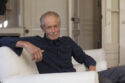
“It required the authority of a woman’s voice to counterbalance my digressions about aging,” explains Erri De Luca, while passing through the French capital to present the book — The Experimental Age —, published by Gallimard —, released just days before a brief and magnificent illustrated ode to Michelangelo’s David — David, Michelangelo. An inquiry into a disproportion — a towering and mighty statue measuring five meters. “The giant was the other, the Philistine Goliath, but history enlarges the victors,” he notes.
He confides that he first felt old when a young woman offered him her seat on the bus; he obviously refused.
“Today, you can see what your own aging face will look like, and an app lets you obtain that image with a simple click.” He has endured three heart attacks, years ago, which he describes as a betrayal by his body. Since then, he remains vigilant. “I apply to aging the criminal categories related to homicide: old age can be involuntary, arriving suddenly due to an accident or illness; premeditated, when one tries to hide its signs; or voluntary, as a new area to be explored,” he explains in the book.
It is a new adventure that begins: “I can say that old age contains stretches unknown to earlier ages, and I can say that it is my best time.”