
“Medicine is a social science, and politics is nothing less than medicine on a very large scale,” wrote Rudolf Virchow. It is through this prism that the resurgence of measles in the United States is read.
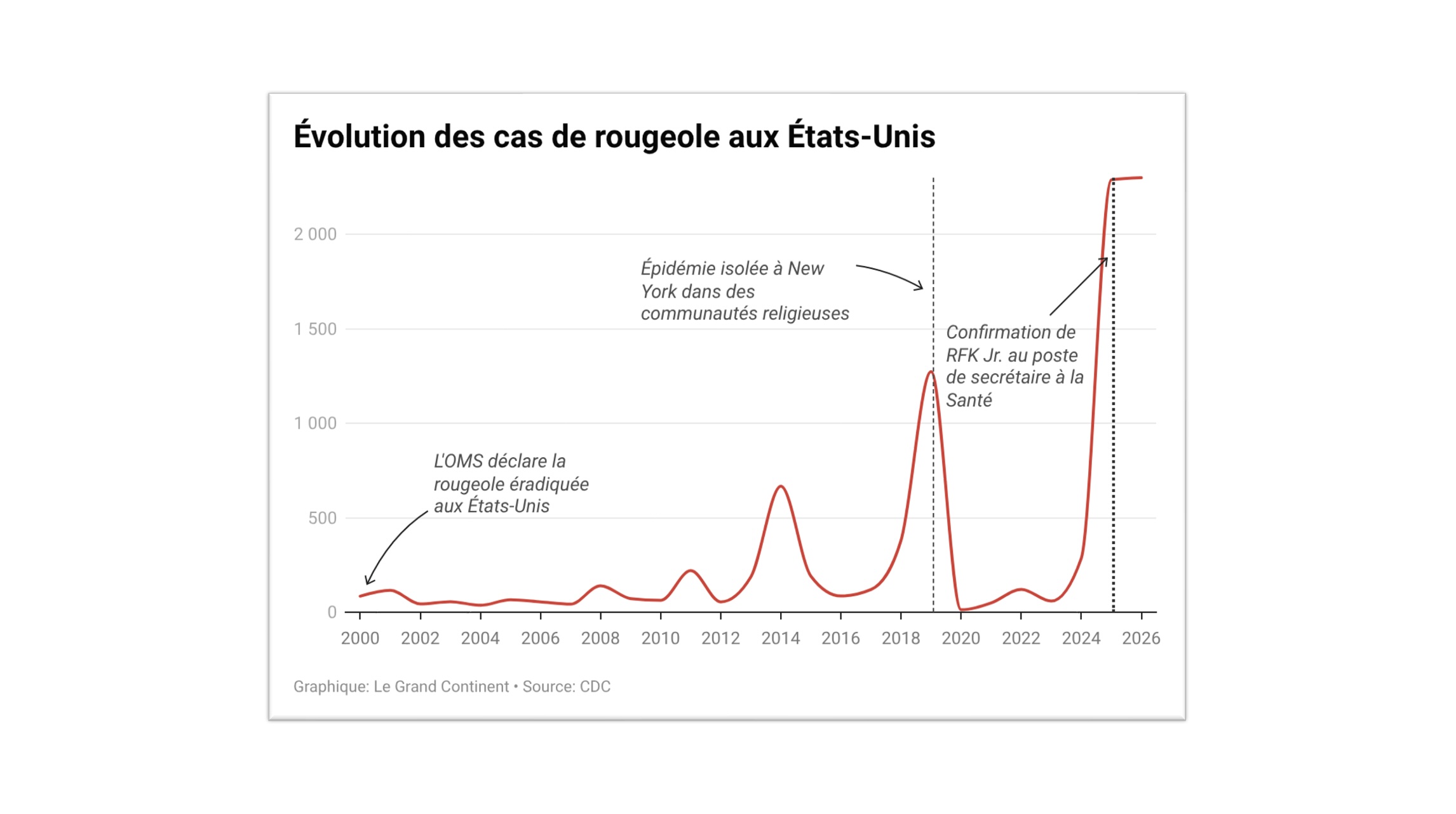
- With 285 cases in 2024, 2,289 in 2025—figures unseen since 1992—and already more than 2,300 by the summer of 2026, we are witnessing a peak never observed since 1991.
This surge coincides with the inauguration of Robert F. Kennedy Jr. as Secretary of Health in February 2025. The elements necessary for this return of the disease were already present, documented, and the subject of numerous calls to action. Thus, by his silence and his refusal to act, his role, as well as that of the Trump administration in driving the disease back, is beyond doubt.
- The United States, the first country to officially “eliminate” measles in 2000, is now deemed “highly susceptible” to lose that status in autumn 2026 if transmission chains persist beyond twelve months.
- They would thus join a trend already set in motion in 2019 by the United Kingdom, Greece, the Czech Republic, and Albania – developed countries where measles has become endemic again due to insufficient vaccination coverage.
Unlike other infectious diseases, measles is a virus that is not highly lethal, but it is by no means harmless.
- Thus, with a lethality of about one death per thousand cases—three deaths in 2025 and no deaths recorded yet in 2026—this is likely what feeds a false sense of invulnerability, one of the main obstacles to vaccination policies.
- It is nonetheless one of the most contagious pathogens known. Its basic reproduction number (R0) is estimated between 12 and 18, meaning that an infected person, on average, infects about fifteen others, a figure even higher within under-vaccinated communities. By way of comparison, the reproduction rate of Covid-19 was estimated at 2.5 to 3 for the 2020 ancestral strain, and at 8 to 10 for the Omicron variant, the most contagious.
- Moreover, morbidity is far from negligible. With a hospitalization rate around 9% in 2025/2026, a rapidly spreading outbreak can lead to hundreds of hospitalizations, sometimes in intensive care. An overload that would weigh on a health system already under strain.
- Infants aged 6 to 12 months form the “blind spot” of protection. Too old for maternal antibodies, too young to be vaccinated, they depend entirely on herd immunity and are the first to be affected when that protection declines.
To understand the public health risk posed by a person with measles, one must understand the notion of “immune amnesia.”
- The principal reason for alarm lies in a phenomenon highlighted by two studies published in Science: the virus infects immune system cells via the surface protein CD150 — “the way SARS-CoV-2 uses ACE2” to enter lung cells.
- By destroying memory lymphocytes, it erases a portion of the acquired immunity. One could say that measles tears out pages from the body’s vaccination log: the immune system normally keeps an up-to-date tally of microbes it has already encountered to respond quickly to new attacks. Deprived of this memory, the individual must “relearn” how to defend against infections it once mastered, leading to overexposure to diseases and higher mortality in the two to three years following infection.
- The authors of the study cautiously speak of a “mini HIV effect,” while noting that the differences with the latter far outweigh the similarities.
- Together with hospitalizations and the economic and psychological disarray they cause, this indirect excess mortality makes the current outbreak a “true time bomb” for the American health system. All the more so since the United States counted more than 500,000 declared cases per year in the 1950s, and the 1989–1991 resurgence peaked at around 27,000 cases in 1990.
Before being named Secretary of Health by Donald Trump, Robert F. Kennedy Jr. had promoted the scientifically discredited narrative of a link between vaccines and autism, stated that “there are no safe and effective vaccines,” and advised parents not to vaccinate their children.
- Confirmed narrowly by the Senate (52–48), he saw the Republican Party split: Senator Mitch McConnell, the only Republican to vote against him, did so precisely because of his positions on vaccination policy. Senator and physician Bill Cassidy supported him only on the condition of “keeping an eye on him.”
- Under congressional pressure, RFK Jr. then performed a 180-degree turn, denying his past statements, including his claim that “there are no safe and effective vaccines.”
- One could thus say that his current line is that of a “moderate, passive-aggressive anti-vaxxer.” On the CDC’s site, he has two doses as providing the best possible protection against measles, while removing the claim that vaccines do not cause autism. This note was replaced, at the end of 2025, by language suggesting that the link has not been ruled out.
- This double language answers a political equation. It is about appeasing Donald Trump’s belief in the vaccine-autism link without triggering a backlash from Republican lawmakers sensitive to the medical argument. His publicly displayed closeness to antivax quarterback Aaron Rodgers, whom he considered as a running mate in the 2024 campaign, already illustrated this strategy.
This strategy of inaction can be better understood by comparing it to the measles crisis of the early 1990s.
- During the 1989–1991 outbreak, which peaked at around 27,000 cases in 1990, the Health Secretary under George H. W. Bush, Dr. Louis Sullivan, mobilized three levers: the large-scale purchase of vaccines at negotiated prices and their free distribution across the country, mandatory vaccination for healthcare workers, and a univocal public information campaign.
- In the face of the 2026 surge, RFK Jr. uses no federal lever: his sole response is a vaccination recommendation kept on the CDC site, accompanied by ambiguous statements. He substitutes individual freedom of choice for public action.
- RFK Jr.’s inaction resembles vaccine-hostility that does not name itself, and which is all the more effective because it offers no direct handle to his critics.
The measles virus does not affect isolated individuals but communities. While national vaccination coverage averages conceal strong local disparities, it is at this scale that the problem arises.
- In the 1990s, non-vaccination was mainly due to material obstacles (cost, access). In 2025–2026, it results from deliberate choices, often political or religious. RFK Jr. himself acknowledged on CNN: “The communities affected are almost all religious communities that simply do not vaccinate.”
- Yet these populations tend to live together, which drives local coverage well below the herd-immunity threshold. Each community becomes a kind of fuel reserve, needing only a spark to ignite. That spark almost always comes from outside: a member of the community, infected during a short trip—often for work—re-imports the virus into a setting that is simultaneously under-vaccinated and highly interconnected.
- From there, a chain reaction, from cluster to cluster, from one community to another. Of the roughly 2,300 current cases, about 1,300 are linked to transmission chains that have never been interrupted since 2025.
- This situation should continue as long as the federal government does not act.