
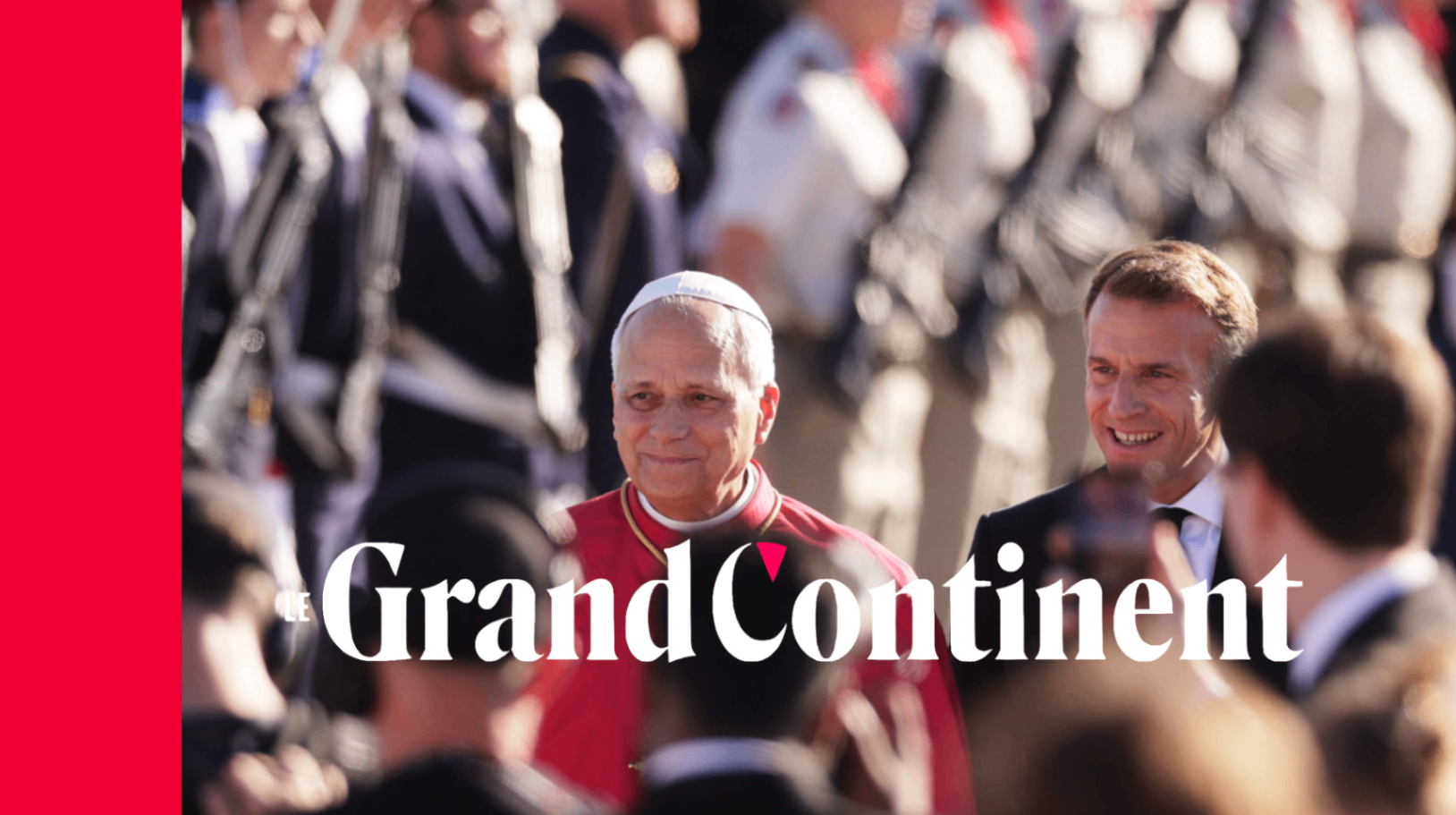
Pope Leo XIV’s visit to France is his fifth apostolic journey. It is also the first official papal visit to France since Benedict XVI’s in 2008, during Nicolas Sarkozy’s presidency, which had been broadly viewed as a public success despite its very intellectual tone.
Although he has set foot on French soil three times as pontiff, Francis has never conceived his three trips as official state visits to France:
- to Strasbourg, he came to deliver a speech before the European Parliament;
- to Marseille, at the invitation of Cardinal Aveline, he chaired the European Meetings on the Mediterranean (a periphery at the heart of his concerns);
- and in Corsica, a conference on popular piety.
Robert Prevost, for his part, has already visited Paris as the Superior General of the Augustinian order, and had gone to Lourdes twice, as a seminarian and a young priest.
Pope Leo XIV was welcomed this morning, Friday the 25th, by Emmanuel Macron, who would then receive him at the Élysée Palace, in the presence of the government, the diplomatic corps, and several other statutory bodies and civil society figures, representative of the scientific and cultural worlds, before whom he would deliver a first address focusing on French issues.
- At 3:00 p.m., he will deliver a second speech at UNESCO’s Paris headquarters, on the theme of AI, which had already been the subject of his first encyclical, Magnifica Humanitas.
- Then, he will stroll in a papamobile through Paris, the Left Bank, starting from the Notre-Dame des Champs parish, along Montparnasse and Saint-Michel boulevards, an occasion for the pope to greet the crowd gathered to glimpse him.
- Pope Leo XIV will then go to Notre-Dame Cathedral where, after greeting the clergy on the forecourt, he will celebrate Vespers at 5:15 p.m. in the presence of a large clergy (bishops, priests, deacons, religious and nuns, consecrated laypeople…), whose access to the cathedral will be reserved for them.
The Friday evening will be devoted to a prayer vigil at the Stade de France, where the pope will address Catholic youth, giving the event the feel of a World Youth Day in a reduced format – the 1997 Paris edition held by John Paul II had been regarded as a success.
- The Stade de France’s 80,000 seats will be filled for the occasion – a parallel with Céline Dion’s European tour was noted.
- As is customary during papal journeys, Pope Leo XIV will spend the night at the Apostolic Nunciature, on Avenue du Président Wilson, in the 16th arrondissement.
On Saturday morning, Pope Leo XIV will go to a emblematic place of the diocese of Paris’s charitable works, Maison Bakhita, in the 18th arrondissement, a reception and accommodation center for migrants, named after Saint Josephine Bakhita.
- In the leaked program drafts, there had first been talk of visiting Maison Jeanne Garnier, a diocesan palliative care facility.
- At 10:15 a.m., he will go to the Institut Catholique de Paris (which celebrated last year its 150th anniversary), in contrast to Benedict XVI, who had delivered his speech at the Collège des Bernardins, a center of teaching and culture desired by Cardinal Lustiger, and conceived as a spearhead for re-evangelization.
- Besides the rector of the Institut catholique, he will meet catechumens and neophytes, as well as members of the Île-de-France synodal assembly held recently on the resurgence of adult baptisms. On the scale of secular Western societies, France indeed serves as a laboratory for the new evangelization, with a wave of conversions among adolescents or young adults to Catholicism that surprised the Church itself.
- In the chapel of the Institut catholique, the church Saint-Joseph des Carmes, which was the first Baroque dome of the Catholic Reformation built in Paris, Pope Leo XIV will pay homage to a Carmelite religious who was one of his spiritual masters, Brother Laurent de la Résurrection.
The afternoon will be marked by the Mass he will celebrate at 3 p.m. on the Place de la Concorde, an unexpected site for a religious service (Benedict XVI had chosen the Esplanade des Invalides, and John Paul II the Longchamp Hippodrome).
- First Place Louis XVI, then Place de la Révolution, the Place de la Concorde is emblematic of the rifts in national memory that culminated in the 19th and early 20th centuries in the “war of the two France.”
- To our knowledge, the last religious service held there was an Orthodox requiem Mass in memory of Louis XVI’s execution, celebrated at the request of Tsar Alexander I at the beginning of the Restoration, during the occupation of Paris by Russian Cossacks.
- More than 600,000 faithful are expected on the Champs-Élysées, up to the Étoile and the Avenue de la Grande Armée.
After Paris, Pope Leo XIV will proceed to the Lourdes sanctuary on Saturday evening, where he will lead a first prayer at the Grotto of Massabielle, the site of the Marian apparitions to Bernadette Soubirous.
- On Sunday, he will deliver at 9 a.m. a speech in the plenary meeting room of the Conference of Bishops of France, which typically holds two sessions per year, one in spring and the other in October, to discuss the main challenges facing the Church in France; it is presided by Cardinal Aveline, highly regarded at the Holy See since the latter years of Francis’s pontificate.
- Then, at 11 a.m., he will celebrate Sunday Mass on the Lourdes sanctuary’s meadow, the underground Saint-Pie-X Basilica not being large enough to accommodate the expected crowd.
The Sunday afternoon will be devoted to various private meetings of the pope: first with hospital workers, caregivers and volunteers who welcome the sick pilgrims at the Lourdes sanctuary, then with Carmelite nuns. Finally, what will likely be the most delicate phase of the trip, with victims of sexual abuse within an ecclesial setting.
- Very little has leaked regarding the organization of this third meeting; some associations of victims of pedocriminality within the Church have denounced it as insufficient, in the sensitive context of closing compensation payments by the Church to the victims, payments likewise judged below expectations.
- Sunday evening, Pope Leo XIV will lead a candlelit procession and will again lead the prayer of the rosary in front of the Massabielle Grotto, in an expression of fervor that echoes John Paul II’s Marian devotion, which he carried out until his final apostolic journey, to Lourdes, in 2004.
The final day of Pope Leo XIV’s apostolic visit, in Metz, will carry a more European and diplomatic tone.
- This Metz stage was added at the request of the Church of France. Expected at Metz airport at 9:20 a.m., Leo XIV will first preside over an interreligious gathering of leaders from different confessions at the Robert Schuman Convention Center at 10:00 a.m.; but it is his second speech, at 11:00 a.m., to be delivered in the same venue, that will likely draw attention.
- Paying homage to the “Father of Europe” Robert Schuman, a Christian Democrat by conviction and, in private, a man of ardent faith who led the orderly and austere life of a devout lay bachelor in the last century – which included daily Mass attendance and the recitation of the Liturgy of the Hours – Leo XIV will not only honor a man whom Pope Francis declared venerable in 2021, i.e., displaying heroic virtues permitting local veneration, the first step toward possible canonization.
He will chiefly defend the cause of Europe and that of “peace and unity,” which the pope regards as inseparably linked to the European project.
- If popes have often advocated a clearer assertion of the “Judeo-Christian roots of Europe,” one must also consider whether, in this appeal for European unity, viewed through the lens of the Holy See’s global role, the pacifist line upheld by Francis, and reaffirmed with force by his successor in the final chapter of Magnifica Humanitas, may not sound somewhat in counterpoint, or even at odds with calls for European rearmament and the assertion of a Europe-as-power – statements that likely go beyond what a neutralist pope by vocation might permit, even if Leo XIV appears to stand more firmly alongside Ukraine.
After that moment, Leo XIV will again move in a papamobile through Metz’s streets, and at 4 p.m. will conclude his journey by celebrating Mass in the Saint-Etienne Cathedral, the city’s cathedral.
After Notre-Dame, Leo XIV comes, in a sense, to belatedly celebrate the 800th anniversary of the cathedral, just as Strasbourg Cathedral’s millennium in 2014 had been a missed encounter between the Alsatian diocese and Pope Francis, who had chosen to visit only the European Parliament.