
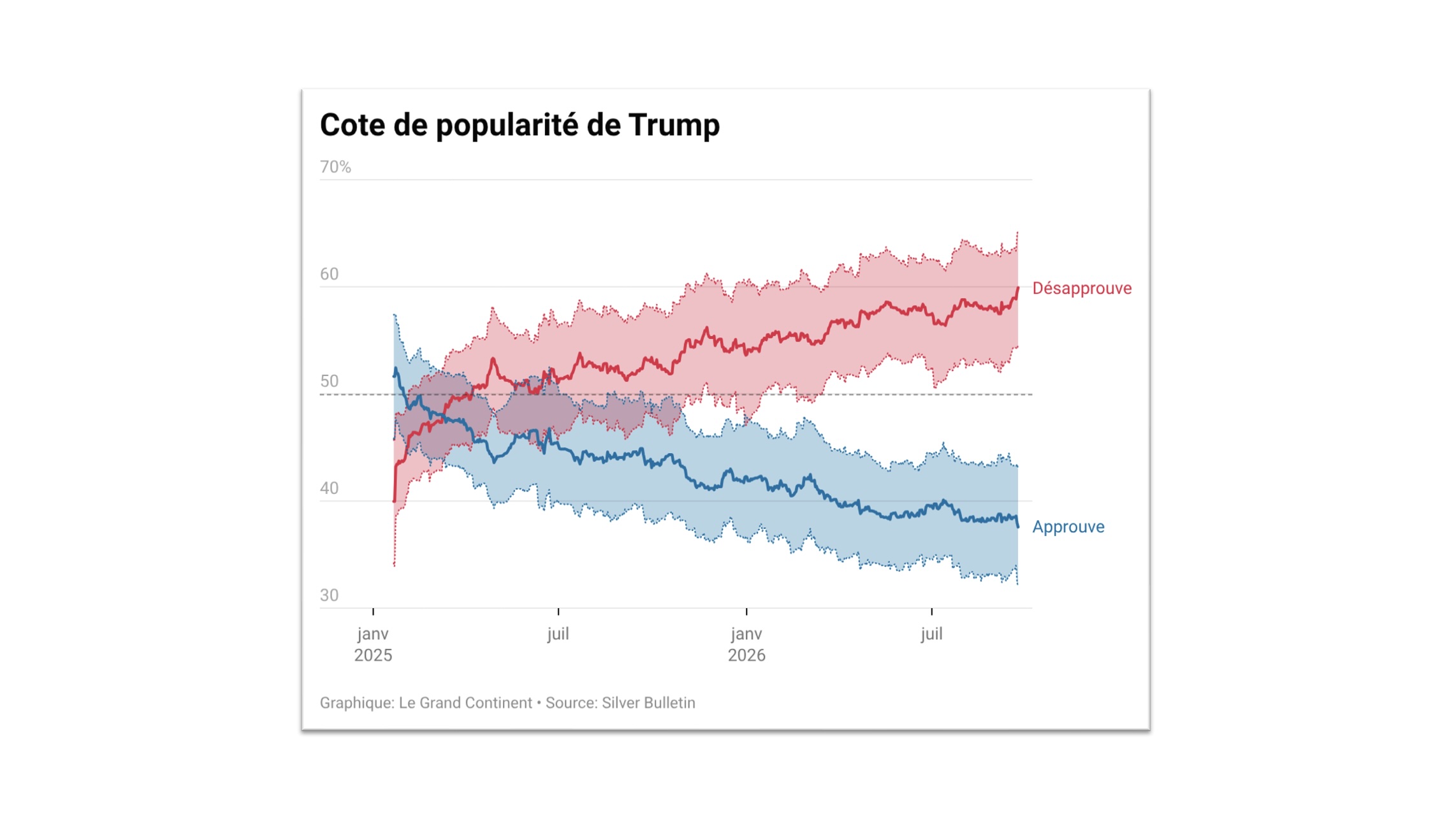
Several Republican candidates aligned with the White House agenda have publicly opposed Trump in recent days over the Iran war, the lavish protocol reserved for Xi Jinping during his state visit, the administration’s immigration policy, and the funding by a Russian oligarch of the wedding celebration for Trump’s eldest son, Don Jr., in May 2026.
According to a report published Monday, September 21, by the American Research Group, Trump’s approval rating has fallen to 29%.
- This marks the first time across his two terms in office that this figure has slipped below 30%.
- At the same time during his first term, the rate stood at 37%, a figure slightly higher between January and September 2018.
- Trump’s popularity has dropped sharply since February, marked by the start of the war against Iran, which has driven a substantial rise in fuel prices.
Thus, proximity to Trump is no longer seen by GOP candidates as a factor capable of winning over undecided Republican voters and independents in the midterm elections.
- Byron Donalds, a House Republican running for Florida governor—with Trump’s “full and total” backing—has removed at least eight references to Trump from the homepage of his campaign site.
- Last week, seven Republican House members voted in favor of a resolution aimed at preventing Trump from launching new strikes in Iran. In two prior votes, in June and July, four Republicans had openly opposed the war.
- The Senate is expected to vote on the measure this week. Senate Republican Leader John Thune could not guarantee GOP unity, notably because several senators, including Dan Sullivan (Alaska) and Jon Husted (Ohio), face tough reelections.
Among Trump’s harshest critics is María Elvira Salazar, a Florida Republican who, in a campaign advertisement aired last week, accuses Trump of having gone “too far” in some of his immigration enforcement measures.
- The video, filmed outside the White House, is aimed specifically at undecided or frustrated voters from the early months of the Trump administration.
- It also reveals the difficulty some Republican candidates face in maintaining a comfortable lead in polling against their Democratic opponents.
- Although Trump won the district Salazar is contesting with a lead of nearly 15 points in 2024, a late-August poll shows the candidates neck-and-neck, each at 45% of voting intentions.
Less than 10% of Republican officials’ online posts mentioned Trump during the first two weeks of September, a figure down six points since the start of the year. They have thus tended to push their own messages aimed at voters, which can sometimes diverge from those of the White House – something that seemed unlikely just a year ago.