
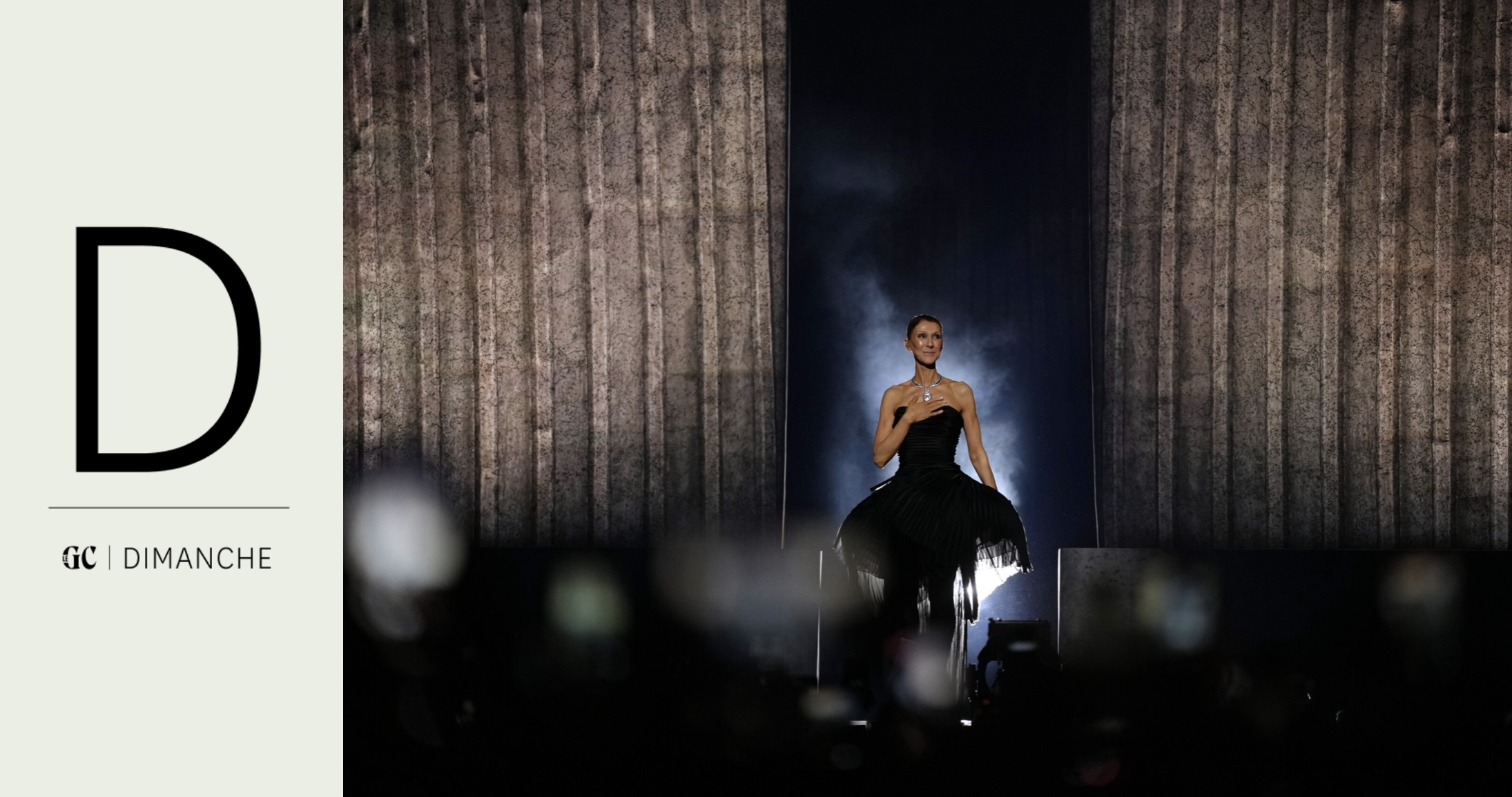
“We don’t change,” she sings at the outset. It’s her welcome line, soft, whispered, then swung. I don’t change either, because before going to see her, I compile, I watch, I listen, in short, I document her. I know her songs, a bit about her life, who doesn’t know her? But there, I dig deeper, I unfold. Beyond the singer, I try, like everyone, to grasp the contours of the Céline Dion phenomenon, and like everyone, I quickly land on Goldman, the rare and taciturn Jean-Jacques Goldman. It is announced from the start that he will not take the stage at the Plénitude Arena; who knows if he will even come to see her, since he is said to be in frail health. I’d rather not think about it. But Goldman serves as my guide and gauge. In the few confidences he gives, he admits that when he first heard her sing his lyrics, he couldn’t get over Céline’s musicality, her precision, and her speed of understanding. “Staggering,” he says. It is here that I try to place myself, in Goldman’s admiration for Céline, their providential meeting which, even if we don’t change, will change everything for her. So much so that going to see Céline is to put myself under Goldman’s tutelage, because Goldman is Goldman. Her songs may be basic, harmless, always a bit the same, but I haven’t found anything better to galvanize me when I falter, to walk alone in the city while crushing dark thoughts or to relive my youth at a lower cost. I love her ease, the vigor of her hits, her hypnotic melodies that reveal themselves at the first chord, and above all this air of not touching it, of never being naïve, of not playing it up, my ideal of celebrity (and not only mine, since he remains, as of the end of December 2025, first on the list of French people’s favorite personalities).
On the set of the Plénitude Arena, the largest indoor concert hall in Europe (40,000 seats), almost everything has already been said, but I will emphasize the two large columns, basalt-gray monoliths, like two dark remnants of a temple to a goddess, and one wonders why they were not cut from whiter stone, purer marble, more imperial. Since Céline will appear on stage only in midnight-blue, black, onyx, quartz, jet outfits, sparkling, one understands that a white marble would have stolen her light from the sole presence that must shine here so that the 35,000 people each evening of her “Residency” can flood in with her. Her Residency, yes. Do you know this word? Me, no, at least not in this sense. It’s borrowed from the American “residency,” and branded by Las Vegas: an artist settles there for a long series of concerts, and it’s the audience that travels, not the artist. The residency is the opposite of the tour, or the tours, the preserve of hyper-stars or tired stars. Céline Dion, however, has been in residence at the Colosseum of Caesars Palace, when she was young and in top form, from 2003 to 2007, then from 2011 to 2019. Over thirteen years, she gave more than a thousand concerts there and wowed 4.5 million spectators. (She has since been imitated by Elton John, Mariah Carey, Adele, Britney Spears.) Here she is at La Défense, for a European residency after six years away, i.e., 26 dates stretched until May 2027, whose economic impact cannot be ignored. A residency allows amortization of production costs and concentrates a flow of visitors on a single territory (Nanterre, Paris, Île-de-France). Hotels, restaurants and shops will benefit from an influx of nearly 800,000 fans, of which 30 to 40% are foreigners, who stay a few days and spend on average between 1,500 and 3,000 euros per person. The mere ticketing generates 4 million euros in taxes for the Bercy coffers, but one must also count tourist taxes, VAT on hospitality, transport, etc. In total, the Céline windfall is estimated at 500 million to 1 billion euros, and could lift France’s GDP by 0.02 to 0.03 percentage points in the year.
But the show seems intent on smothering all this financial clamor, choosing purity and intimate fervor. Everything points to the one and only diamond that glitters deep within what might resemble a mine: Céline. The two gray monoliths become doors that open and close during the performance.
I attend its third date, Friday, September 18, lost in a crowd arriving from every corner of France and the world. I hear all languages, all accents. I know I am privileged, that people envy me this seat, starting with my daughters who urge me to send them real-time videos. I, who hate filming what I discover, oblige and shoot I’m Alive, My Heart Will Go On, Destin and, of course, Pour que tu m’aimes encore. Each time, my daughters reply in kind, finish all the songs in capital letters. (I should note that one of them is in a different time zone.) Some fans, they came with two phones to film and record the show without battery limits.
Around me, it’s fair to say the audience is overwhelmingly female. The men there feel like those who accompany their wives into boutiques while waiting for things to happen (I’m exaggerating a touch). The girls came in packs, across generations, or in pairs, between best friends, thirty-somethings, fortysomethings and beyond, accomplices who know the words to every one of her songs by heart and who, while Céline sings, look at each other to sing them together and with her, as if they must double the impact, eyes meeting. I am alone but I sing with them. Why is it so pleasant, so exhilarating to shout the same verses and choruses in chorus? What does it touch? What does it unite in us beyond a shared memory? Of contemporaneity? More, an ideal synchronicity? From one to all in unison? Swedish researchers found in 2013 that the heart rates of choristers synchronize when they sing together and more so on the unison; their cortisol levels (stress hormone) fall while endorphins and oxytocin rise. It’s obvious here. It’s girlish to the extreme, it shouts the very strident ‘Cé-lêe-ne’ that sometimes makes me cover my ears, but it is good-natured, as we would want all stadiums to be in other circumstances. Is it because there is no real stakes, or because it is predominantly feminine? No comment. It is so tranquil at heart that when these 35,000 people leave and sweep the Défense esplanade, they only hum harmless ‘Pour que tu m’aimes encore’ and never seek to clash with anything except their own romantic impulses. We don’t settle scores with Céline; we love her, accompany her, adore her and protect her since, from the height of her immense power, she has become so fragile.
Let’s see.
Graceful, she is. Slimmer than ever, slightly emaciated, hollowed, with no obvious cosmetic surgery, hair drawn into a ballerina bun, wrapped in gowns reminiscent of Marlene Dietrich (her dresser must have drawn inspiration from the German actress’s 1950s Las Vegas shows as well), more of a diva than ever, moved into another stage of her life, less buoyant certainly, more grave, more composed, a bit mineral, almost a widow’s air as she perches on a black rock to wear the attire of the diva among divas, the Callas, for the moment of an aria under a cape (literally, a gorgeous powder-pink cape by Givenchy), ‘Ebben? Ne andrò lontana’ by Alfredo Catalani, a tune made famous by the film Diva indeed. Of course there is kitsch in the performance, that goes without saying, a mountain of kitsch even, powder pink to boot, except that Céline is so eminently likable that one forgives her. Likeable and cabotin, a true drama queen who moans, sniffles, softens but recovers and moves on quickly, upright despite her leanness, legs spread to breathe better, Johnny Hallyday-esque, conqueror, virile.
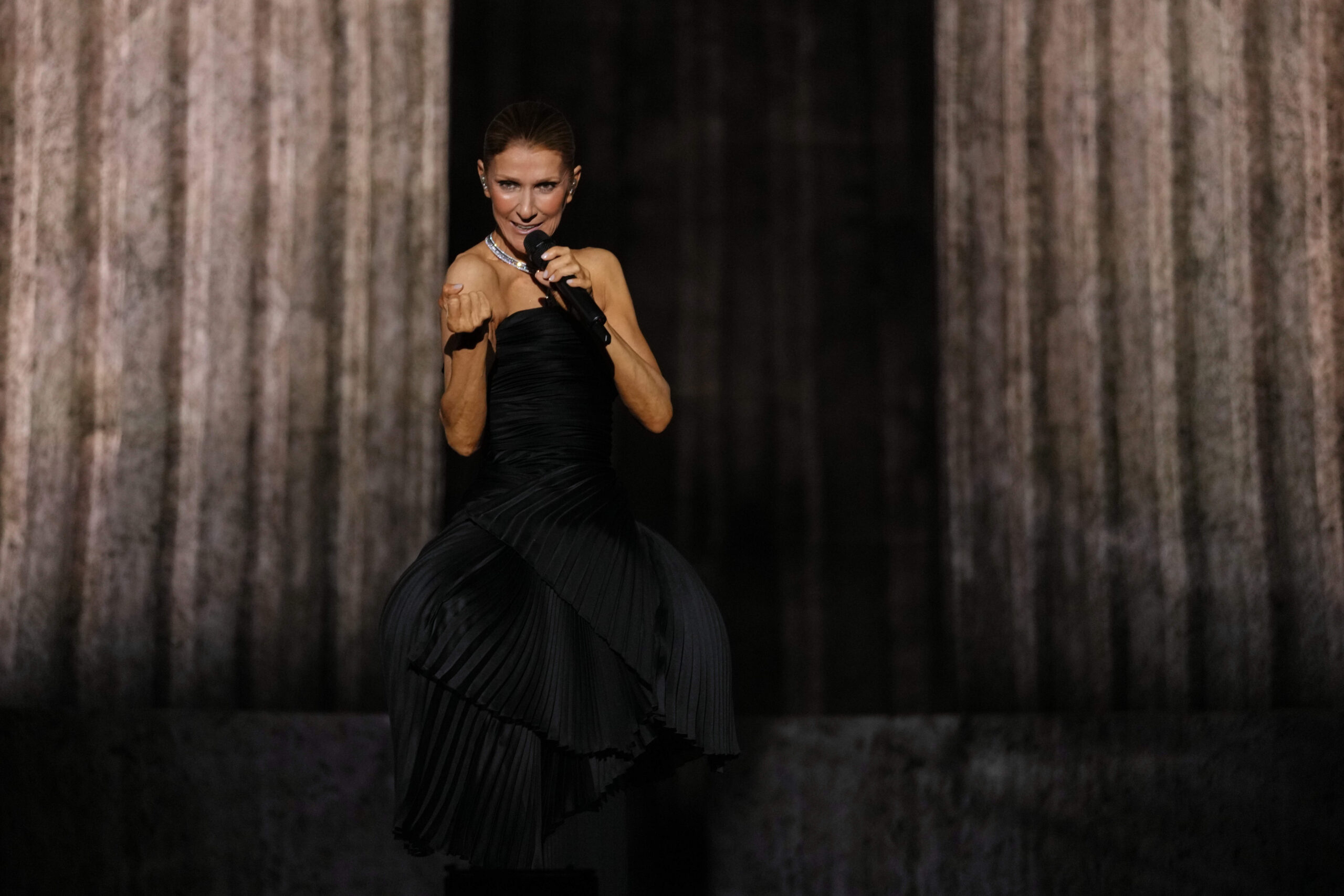
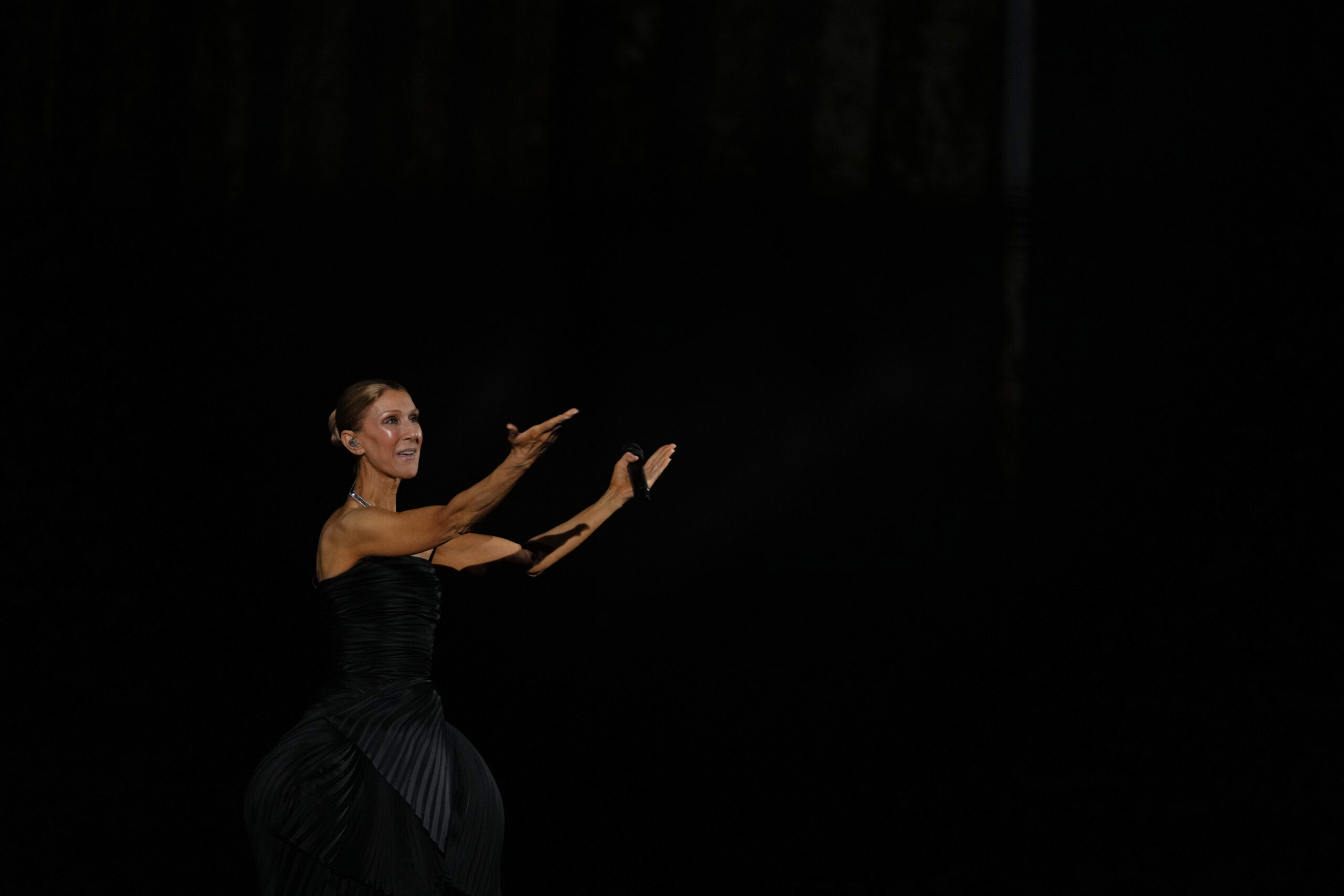
Thus at once graceful and virile. It takes both to incarnate the persona she has forged for herself, the lover of lost causes, like the other American diva before her, Barbra Streisand. In the duo they formed in 1997 to sing Tell Him, one could perceive the brazenness (dripping) of these two women, let’s say physically unconventional, ready to do anything to win the man who pushes them away, to win his heart by occupying the field with a ‘hutzpah’ (‘boldness’ in Yiddish) that goes beyond bounds. Together, they exhibited a sentimental bravery endowed with audacity worthy of Racine’s heroines without a diadem, for it will never be said enough: the love-struck ones move mountains (Love Can Move Mountains, the title of one of her songs), whether those mountains are a rival, an empire or a lover who does not love them back (Phèdre, Hermione, Roxanne, Bérénice), as here in less poetic form, with Ziggy the friend who does not want her, ‘Et moi, je l’aime, c’est pas d’ma faute. Même si je sais qu’il ne m’aimera jamais.’
From the baroque show to the pared-down tragedy, Céline traces lines of continuity, builds bridges from one continent to another, and above all offers us, our singular French-speaking American singer, almost an oxymoron, but not quite. It is, by her own admission, what Goldman sought when he approached her, considering this voice “misused,” as Michel Berger did before him, who died too young to imagine a new repertoire for her. What would have happened, after all, if Berger hadn’t died in 1992? Which of the two songwriters would have had the ascendancy over the Quebecois interpreter? Would she have chosen ballads or bravado? The piano of one, or the guitar of the other? Hard to decide. What is certain, however, is that the 1990s is the decade of the turning point, the great reversal, the years that would make Céline Dion reconnect with her original modesty, a value that rhinestones and shows never erase in the eyes of her fans, as strange as that may seem. Even in Dior, people find her close, familiar, “like them,” and it would be overly pretentious of me to try to persuade them otherwise. (How to be “like them” when you are so adored, pursued, hailed by tens of thousands of fans, and rich beyond millions? This single residency should bring in around 200 million euros gross.) And yet, this decisively regained quality is owed to Goldman, unless Goldman merely allowed her to return to the foreground; both options are possible, but when she steps forward to sing J’irai où tu iras with another, one of her backup singers, as sentimental as I am, I mutter to myself, I am scandalized, I demand Goldman. But no! It is forbidden, to sing that with another! She has done it, with Garou, but not here, not in Paris, not with a backup singer, no, no and no, it would be a betrayal! The next moment, I reason with myself: all right, Goldman isn’t here and probably never will be again, but why doesn’t she have a word for him? Why say nothing about the man who reshaped her entire career? An interpreter doesn’t spend her time naming the authors and composers of her songs, fine, but Goldman is more than that; he is her mentor, her obvious Pygmalion, the man who, in four years, took her from the Olympia to the Stade de France, and who wrote for her an album titled D’eux (Which comes from them? D’eux for two, her and him?). To the ungrateful Galatea who had until then poured out her sorrows in a honeyed English, she used to perform songs written for others, I want to ask: ‘Doesn’t he deserve a small tribute? Don’t you hear, Céline, that it is on his songs that your audience is most fervent?’ (During her English-language tracks, people sit back down en masse.) Could it be that the discreet Jean-Jacques asked her not to do so? That it is no longer something for today’s audience? Or is there some unspoken motive between them, a rift, any sort of dispute? Everyone wonders, no one knows.
I, for my part, loved the intimate partnership they formed from 1995 onward, their friendship, their camaraderie – I, in her place, would have been deeply in love with Jean-Jacques – that before coming, I watched again all their duos on stage, their television appearances, their studio sessions, etc. I must admit that if there were a quarrel, I could not bear it. In those old footage, affection passes, but it is always Céline who teases him or kisses him, the initiative coming from her, the extrovert, while he prefers to stay within his role of humble and shy servant. It remains that it is thanks to Goldman’s songs that Céline finally discovers a “self” of her own, more intimate, more embodied, and in her own language. I’ll Go Look for Your Heart, J’irai où tu iras, Je sais pas, J’attendais, Je crois toi, Je chanterai… And Céline knows it, she who begins by rejecting the idea of singing Pour Titanic in 1997, a song perhaps not aligned with her new persona, but she is mistaken, for shouting her love at the bow of a sinking ship also belongs to sentimental audacity. (She says somewhere that after Goldman, she would like not to work with anyone else.)

From then on, the message shifts in tone and the audience, struck at the heart, discovers her tears.
“From where does it come that we laugh freely in the theater and yet are ashamed to cry there?” La Bruyère asks in The Characters, offering the following explanation: laughter gives an advantage over what is shown, while tears betray a weakness we prefer to hide. Yet before Céline, no one is ashamed, no one hides either to cry or to belt out off-key, on the contrary: everyone exults in an unruly and highly sentimental catharsis like nothing else. We cry for her wrecks, her losses, her vanished loves, Céline’s rare illness, René’s death, “You don’t know what your neighbor is going through at this moment, everyone has their trials,” she says during the concert. Or even more starkly, we cry for nothing, nothing in particular. We cry because everyone cries, we cry because the natural tilt of the singing induces torrential pity, a fundamental sadness and amplifies the existential lack, the inexorable elegy that binds us. We cry because it purges us, for reasons we do not know, but the mood lightens. Really? would La Bruyère have doubted since, for him, easy tears purge nothing but soften, which is well captured by the word ‘cheesy’ when it comes to describing this kind of emotional outflow. Still, this tendency (of girls) to wail along to refrains inside the Plénitude Arena or in their bathrooms tells a story of abandonment, a release almost physiological, a near-pure expenditure as Barthes would put it, like that unforgettable scene from Comme t’y es belle where Valérie Benguigui powers herself up alone in her car to Pour que tu m’aimes encore. This impulse is visceral; some will even find it crude, vulgar, but in my view it has the advantage of stirring in us an archaic pleasure, blurring the line of our possible selves and thus giving us wings for the duration of a song. In its wake, snobbery could condemn it entirely. One could say that unlike other great voices—Streisand, Adele—Céline neither wrote nor composed any of her songs, argue that her audience understands nothing of opera because they scream before she even reaches the final note on Catalani’s aria, praise her vocal performances as mere athletic feats, but to roast all these shortcomings, firstly, would be too easy; secondly, it would miss the phenomenon or simply scorn it without understanding. And as for me, to deprive myself of such juvenile joy would be a loss.
The cult of Dion is neither quiet nor sober; it is kitsch, childish and loud, responsive “to the insistent rhythm of our heartbeats.”