
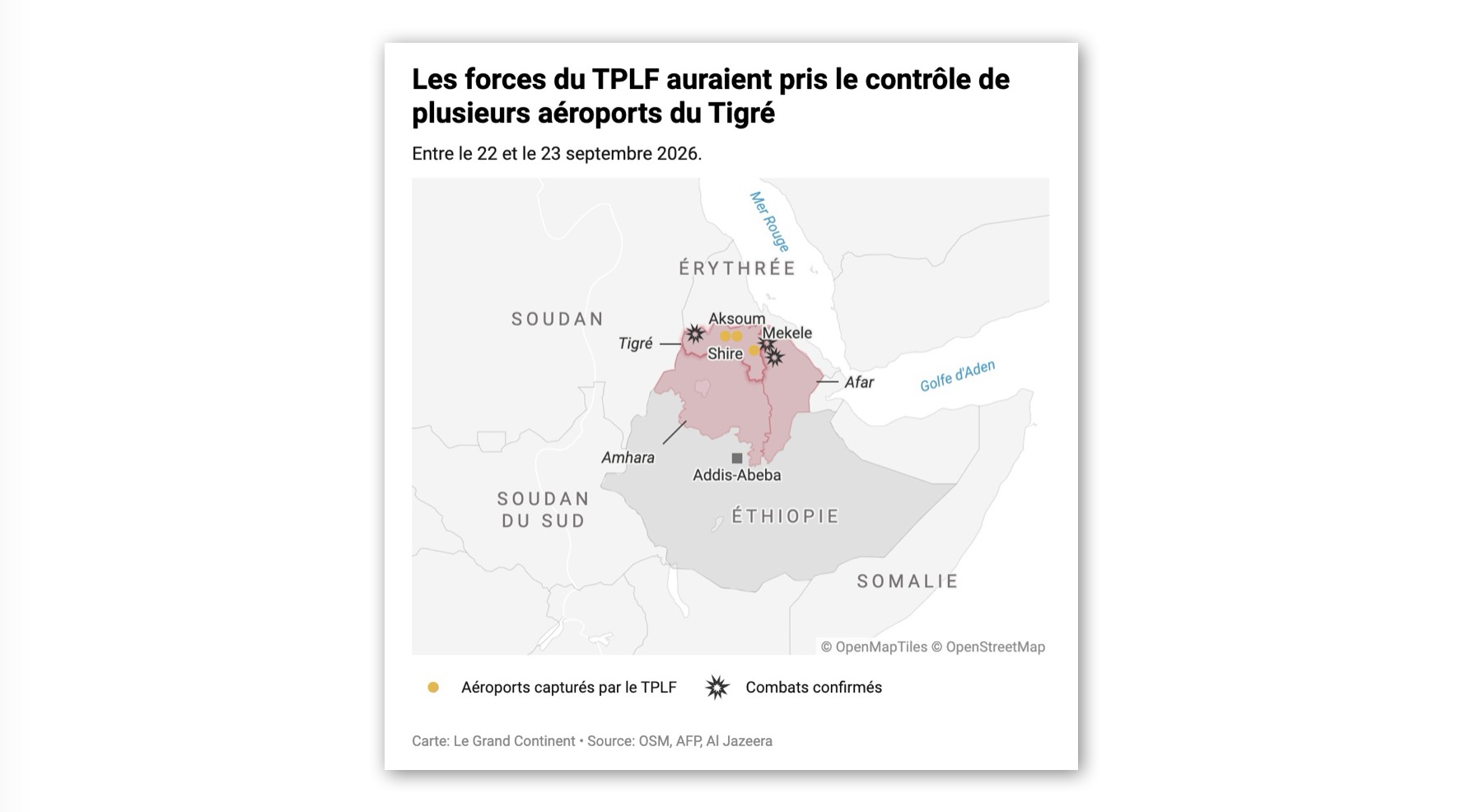
The Tigrayan forces of the TPLF took control in the night between Tuesday and Wednesday the 23rd of a number of airports in Tigray and launched a “total offensive” against government positions in the Afar and Amhara regions, according to Getachew Reda, the prime minister’s senior adviser and former TPLF leader. A senior official in Prime Minister Abiy Ahmed’s government said these forces had launched a “large-scale” offensive against the federal government, shattering the Pretoria Agreement.
The authorities in Tigray, for their part, say they have entered a “defensive” war.
- The war in Tigray began in November 2020 when forces of the Tigray People’s Liberation Front (TPLF), then in power in the region, attacked bases of the federal army, followed by an offensive by the government of Prime Minister Abiy Ahmed.
- The conflict followed Abiy’s dissolution of the Ethiopian People’s Revolutionary Democratic Front (EPRDF), a ruling coalition long dominated by the TPLF, in favor of a single-ethnicity-free party, the Prosperity Party.
- An agreement brokered under the auspices of the African Union and signed in Pretoria in November 2022 ended the main fighting without delivering a lasting peace. Human Rights Watch noted in particular that the document did not explicitly mention the ethnic cleansing carried out against Tigrayans by regional forces and Amhara militias in western Tigray.
Tensions between the Ethiopian government and the Tigray Defence Forces, the armed wing of the TPLF, have continued to intensify in recent months.
- On Sunday, September 20, a drone struck a convoy of the American NGO Catholic Relief Services transporting food aid for internally displaced people.
- The strike, which destroyed a truck, was condemned by Washington, though no perpetrator was named.
- The government in Addis Ababa also did not comment on the incident.
That same day, seven armed groups, including the TPLF, the Amhara Fano militia and the Oromo Liberation Army, announced the formation of an “Alliance for Survival” aimed at toppling the Ethiopian government. Addis Ababa has for months accused the TPLF of aligning with armed groups active in other regions of the country as well as with Eritrea, which it suspects of financing these movements, something Asmara denies.
- The resumption of the conflict in Ethiopia threatens to spark a broader regional conflagration that could draw in neighboring countries such as Sudan, which has been engulfed in civil war since 2023, and Eritrea.
- The region remains heavily scarred by the 2020-2022 war, with about one million people still displaced. The African Union estimates that at least 600,000 civilians were killed during the war.